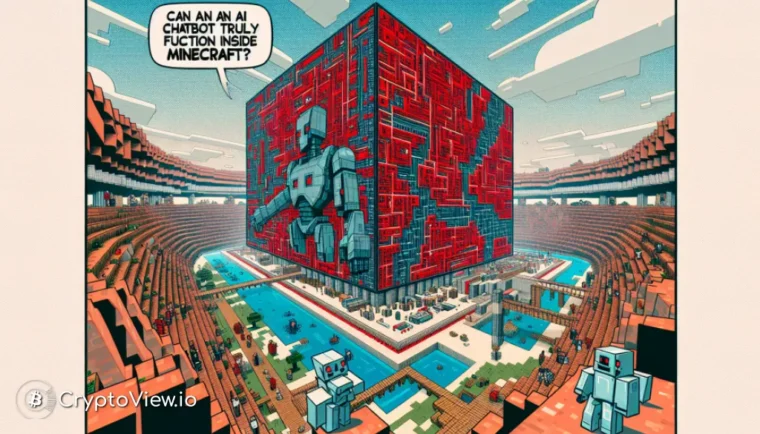
A monumental achievement in digital engineering saw a builder encode a 5-million-parameter language model entirely within Minecraft’s redstone logic, spanning over 439 million blocks. While excruciatingly slow, taking hours for a single response even with speed boosts, this incredible project demonstrates that a functional AI Chatbot Minecraft is indeed possible, pushing the boundaries of in-game computation.
Price of Worldcoin (WLD)
The Redstone Revolution in a Block World
For years, the creative minds behind Minecraft have pushed the boundaries of what’s possible within its blocky confines. Redstone, the game’s equivalent of electrical wiring and logic gates, has been the bedrock for intricate contraptions, from automated farms to fully functional in-game computers. This latest endeavor, spearheaded by a builder known as Sammyuri, takes redstone engineering to an unprecedented level: implementing a language model inference engine.
Imagine constructing a complex neural network, not with silicon and code, but with virtual blocks, repeaters, and comparators. That’s precisely what this project accomplished. Without relying on command blocks or external modifications (save for rendering assistance), Sammyuri meticulously crafted a vast, sprawling network that emulates the fundamental operations of a large language model. It’s a testament to the universal nature of computation and the sheer dedication of the Minecraft community, demonstrating that even a rudimentary AI Chatbot Minecraft can be realized through sheer will and intricate design.
Deconstructing the Minecraft AI’s Inner Workings
The journey to create this in-game AI began outside Minecraft. The creator first trained a compact language model in Python, leveraging a dataset dubbed TinyChat. This model, boasting approximately 5,087,280 parameters, featured an embedding dimension of 240, a vocabulary of about 1,920 tokens, six layers, and a context window of 64 tokens. Most of its weights were quantized to 8 bits, though certain elements like embedding and LayerNorm weights maintained higher precision for accuracy.
Once trained, the challenge shifted to transcribing this model’s inference logic into redstone. The resulting build is colossal, occupying an area roughly 1,020 × 260 × 1,656 blocks—totaling an astounding 439 million blocks. When a prompt is entered via an in-game interface, the redstone circuits meticulously execute each step of the inference process: embedding lookups, feedforward passes, matrix multiplications, and softmax approximations. This elaborate construction took months of dedicated effort, culminating in a system that, while technically operational, operates at a glacial pace.
Beyond Practicality: A Philosophical Statement
Despite the engineering marvel, the practical utility of this redstone-powered AI is virtually nonexistent. Even with an artificially boosted tick rate—a staggering 40,000 times faster than standard Minecraft speed via MCHPRS—a single response can still take several hours. At the game’s normal speed, some estimates suggest generating an answer would stretch over nine years. Clearly, this isn’t a competitor to modern AI assistants; its purpose lies elsewhere.
This project stands as a profound proof of concept, a piece of technical art that playfully demonstrates the universality of computation. It highlights that neural inference can be mapped onto almost any logical substrate, reminding us of the layers of abstraction inherent in our software and hardware stacks. It prompts us to consider what truly defines a model: its architecture, its medium, or its speed? The build has sparked considerable debate across online forums, from Tom’s Hardware dissecting its block count to Hacker News commenters marveling at the engineering while noting its limitations. It’s a conversation starter, challenging our assumptions about where and how intelligence can manifest.
Trend of Worldcoin (WLD)
Minecraft’s Shifting Sands: Crypto, NFTs, and AI
It’s fascinating to see such advanced computational feats emerge within a game that has historically maintained a strict stance against certain digital integrations. For instance, in a notable move in late 2023, Minecraft’s developer Mojang and publisher Microsoft had famously cracked down on the integration of cryptocurrencies and NFTs within fan-operated servers, aiming to protect players from speculative markets and potential scams. This firm stance made headlines and set a precedent in the gaming world.
However, the landscape isn’t entirely static. Around the same time as the crypto and NFT crackdown, there was market buzz regarding Worldcoin’s integration with Minecraft. This move, which seemed to diverge from the established policy, highlighted the complex and evolving relationship between traditional gaming platforms and the burgeoning Web3 ecosystem. Such developments underscore the dynamic nature of digital asset adoption within mainstream entertainment, constantly challenging and reshaping our perceptions. Staying abreast of these shifts, especially in the intersection of AI and blockchain, is crucial for anyone navigating the digital economy. Tools like cryptoview.io can offer valuable insights into these evolving market trends, helping users identify potential opportunities and understand the broader implications of such integrations.