
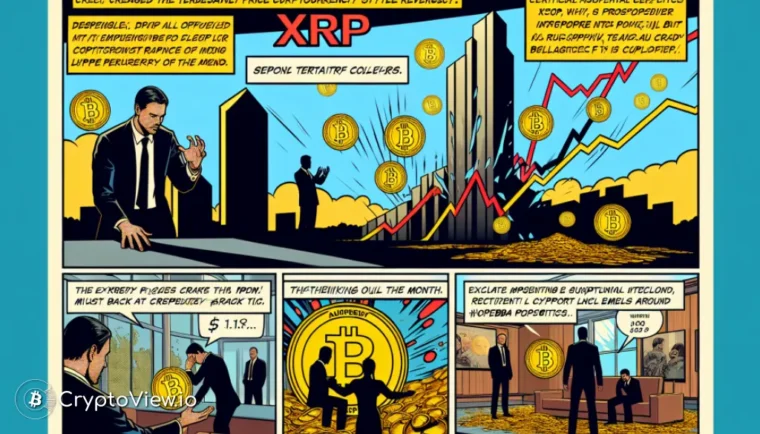
On January 26, 2026, XRP experienced a significant price reversal, wiping out its earlier monthly gains and returning to critical support levels around $1.88. This sharp downturn, despite positive institutional inflows, has prompted a re-evaluation of its immediate recovery prospects, forming a key aspect of any XRP January price analysis.
Price of Ripple (XRP)
Unpacking the January Reversal
The final trading day of January 2026 saw XRP’s promising rally unravel dramatically. After an earlier surge, the digital asset plummeted, erasing its month-long advance in a single session and settling near the $1.88 mark, with a downside wick touching $1.81. This sudden downturn left many traders questioning the sustainability of its recovery attempts.
Momentum indicators offered little comfort during this period. The Relative Strength Index (RSI) remained subdued, while the Moving Average Convergence Divergence (MACD) showed persistent weakness, signaling a clear lack of strong bullish conviction among market participants. The immediate challenge for XRP was to stabilize above $1.88, as failure to do so risked a further breakdown.
Institutional Resilience Amidst Price Volatility
Despite the sharp price correction on January 26, institutional interest in XRP appeared to hold firm. Bitwise recorded a notable $3.43 million in inflows for XRP, indicating continued institutional conviction. Furthermore, by January 23, 2026, XRP ETFs had collectively attracted over $1.36 billion in total inflows. These figures suggest that major players and institutions were not quick to abandon their positions, even as the price faltered.
This steadfast institutional support raises an intriguing question for our XRP January price analysis: how long can these ‘diamond hands’ continue to accumulate or hold if XRP consistently underperforms its peers? The continued inflow of capital into XRP-related products highlights a long-term belief in its potential, yet the immediate price action often tells a different story, creating a fascinating dichotomy for investors to navigate.
Whale Accumulation and Market Dynamics
A significant trend observed during XRP’s recent dip was the aggressive accumulation by whales. On-chain metrics from CryptoQuant revealed a surge in whale activity as XRP’s price fell below the $2 threshold, intensifying notably once it hit $1.88. This data suggested that large holders viewed these lower prices as a prime opportunity to increase their holdings, perhaps anticipating a strong rebound.
Despite this substantial buying pressure from whales, the price struggled to maintain its footing, leaving XRP in a precarious position around $1.88. The market buzz indicated a battle between these large-scale buyers and broader selling pressure. Can whales alone continue to prop up XRP’s value, or is the current dip too formidable for even their collective buying power to overcome?
Trend of Ripple (XRP)
Leadership Optimism Versus Technical Realities
Earlier this January, Ripple CEO Brad Garlinghouse publicly expressed strong optimism at the World Economic Forum, stating his belief that XRP would eventually reach an all-time high. His bullish outlook was predicated on increasing adoption of Ripple’s technology and a clearer regulatory landscape for cryptocurrencies. However, XRP’s recent price performance has struggled to mirror this sentiment, creating a noticeable disconnect between executive confidence and market action.
Technically, XRP hovered at a critical inflection point throughout this period. The $1.88 level served as immediate support, with a failure to hold it potentially exposing the next major support at $1.73. A decisive breakdown below $1.73 could accelerate selling pressure and deepen the retracement, keeping traders focused on these near-term technical structures rather than long-range forecasts. For those tracking market movements, applications like cryptoview.io offer essential tools for monitoring these critical price levels and on-chain metrics, helping investors make informed decisions. Find opportunities with CryptoView.io


