
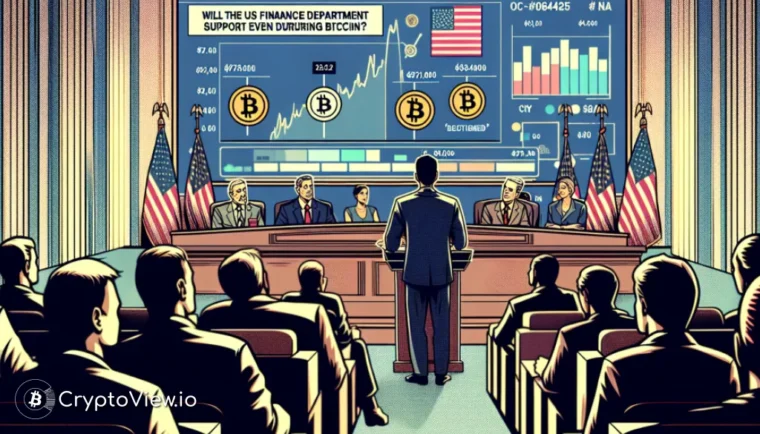
In early February 2025, amidst a dip that saw Bitcoin briefly fall below $73,000 as Asian markets opened with bearish inclinations, then-Treasury Secretary Scott Bessent clarified the government’s stance on digital asset interventions. His testimony before Congress unequivocally outlined the official US Treasury Crypto Policy: no direct market support for Bitcoin, even in a slump, a position that continues to shape regulatory perspectives today.
Price of Bitcoin (BTC)
The Treasury’s Stance: No Bitcoin Bailouts
During a lively congressional hearing on February 4, 2025, former Treasury Secretary Scott Bessent faced a barrage of questions from lawmakers, particularly from California Congressman Brad Sherman, known for his critical views on digital currencies. Sherman pressed Bessent on whether the Treasury Department or the Federal Open Market Committee possessed the authority, or had any plans, to "rescue" Bitcoin should it face significant market distress. The exchange underscored a persistent tension between crypto enthusiasts hoping for governmental support and a regulatory body keen on maintaining a hands-off approach to market fluctuations.
Bessent’s response was clear: while the U.S. government would continue to hold and manage seized cryptocurrency assets, it had no intention of instructing banks to purchase Bitcoin to stabilize the market. He explicitly stated, "As Treasury Secretary, I do not possess such authority, nor do I as the head of the Financial Stability Oversight Council (FSOC)." This declaration firmly established that market participants should not expect a governmental safety net for Bitcoin, reinforcing the decentralized ethos many in the crypto community *HODL* dear. Interestingly, Bessent also highlighted that the U.S. had already generated billions in value by holding confiscated Bitcoin, a strategy that stemmed from a previous administration’s executive order in March 2025, which had launched an initiative for a strategic Bitcoin reserve.
Political Crosscurrents and Digital Assets
The congressional testimony wasn’t just about financial policy; it was also a stage for political theater. Congressman Sherman’s line of questioning, probing the Treasury’s willingness to intervene in Bitcoin’s market, was widely interpreted as a subtle jab at the previous administration’s vocal interest in cryptocurrencies. This political undercurrent highlighted the diverging views within Washington on how digital assets should be perceived and regulated.
The broader discussion reflected an ongoing debate about the role of government in the burgeoning crypto economy. While some lawmakers advocate for stringent oversight and consumer protection, others see cryptocurrencies as an innovation to be fostered, albeit with careful consideration. This dynamic interplay between innovation and regulation continues to define the landscape for digital assets, with the US Treasury Crypto Policy playing a pivotal role in shaping investor confidence and market direction.
Trend of Bitcoin (BTC)
Retrospective: The World Liberty Financial Controversy
Beyond the direct crypto discussions, the hearing also touched upon the controversial World Liberty Financial (WLFI) affair, a topic that had garnered significant media attention in late 2025. At the time, speculation was rife that if Republicans were to lose the midterm elections and the then-President faced impeachment by year’s end, WLFI could be a contributing factor. The Wall Street Journal had reported that UAE’s Sheikh Tahnoon bin Zayed Al Nahyan had indirectly acquired shares in WLFI-related companies, sparking accusations of favoritism regarding AI chip deals due to covert investments.
When questioned about these allegations and the potential for an investigation into World Liberty Financial, Secretary Bessent largely deflected, asserting the independence of the Office of the Comptroller of the Currency (OCC) and avoiding direct answers. This evasiveness led to a heated exchange with Democrat Representative Gregory Meeks, who publicly urged Bessent to cease "shielding the President." This incident, now a retrospective look at a past political firestorm, underscored the intertwined nature of finance, politics, and emerging technologies, even as the government grappled with defining its stance on digital assets.
Understanding these historical policy discussions and their implications is crucial for anyone navigating the crypto markets. For those seeking deeper insights into market trends and regulatory shifts, platforms like cryptoview.io offer valuable tools for analysis and informed decision-making. Stay ahead of the curve with comprehensive data and expert analysis. Explore CryptoView.io Today


