
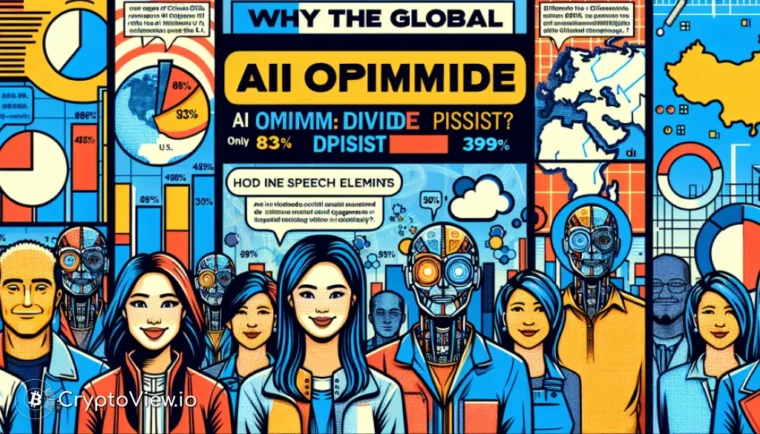
A recent Stanford HAI survey revealed a stark contrast in AI perception, with 83% of Chinese respondents expressing optimism compared to a mere 39% in the U.S., highlighting a significant Global AI Optimism Divide. This divergence, a substantial 44-percentage-point gap, underscores vastly different cultural and societal engagements with artificial intelligence technologies across the globe.
Price of Ethereum (ETH)
Unpacking the East-West AI Perception Gap
The latest data from Stanford University’s Human-Centered Artificial Intelligence (HAI) Institute has once again brought to light a fascinating chasm in public sentiment towards AI. While interest in advanced AI solutions is skyrocketing across Asian economies, Western nations continue to approach these innovations with a more reserved, often cautious, outlook. This isn’t just a minor discrepancy; it’s a profound difference in how societies perceive the benefits versus the risks of AI.
For instance, the survey indicated that a staggering 83% of individuals in China believe AI products and services are more advantageous than detrimental. This figure represents the highest level of AI confidence recorded worldwide. Similarly robust optimism was observed in Indonesia (80%) and Thailand (77%), where large majorities conveyed strong faith in AI’s positive societal contributions. Conversely, Western counterparts reported significantly lower trust levels. Only 40% of Canadians, 39% of Americans, and 36% of Dutch respondents viewed AI as overwhelmingly beneficial, reflecting a deeper skepticism.
A Slow Thaw in Western Skepticism: Bridging the Global AI Optimism Divide
Despite the prevailing caution, the Stanford report did note a gradual, albeit slow, improvement in AI sentiment within Western countries. Since 2022, positive attitudes have seen a notable uptick, with Germany and France experiencing a 10-percentage-point increase. Canada and Great Britain each recorded an 8-point gain, while the United States saw a modest 4-point rise. This incremental shift suggests that increased exposure to practical AI applications, from productivity tools to automation systems and governance technologies, is slowly chipping away at initial reservations.
The Ipsos dataset, covering 2022 to 2024, corroborates these changes, illustrating a consistent, region-specific growth in AI confidence as practical applications become more commonplace. It seems that as people interact more directly with AI in their daily lives, the fear of the unknown begins to recede, replaced by a growing appreciation for its utility. This trend, while not closing the gap entirely, indicates a potential path towards more unified global perspectives on AI’s role in society.
Buterin’s Insight: AI Echoes Gene Editing’s Divides
Ethereum co-founder Vitalik Buterin, ever the astute observer of emerging technologies, pointed out that this East-West divergence in AI sentiment isn’t an isolated phenomenon. He drew a compelling parallel to public trust in other cutting-edge scientific fields, specifically gene-editing research. Referencing the Pew Research Center’s International Science Survey from 2019–2020, Buterin highlighted how similar patterns of trust and skepticism emerged.
The Pew data showed that approval for gene editing was highest in nations like India (56%) and Taiwan (44%), while Japan registered the lowest regional belief at 26%. In the Americas, Canadians (60%) and Americans (60%) largely aligned with Brazil (63%). European responses, however, varied significantly, with France (75%) and Germany (68%) showing high approval, contrasting sharply with Italy and Poland, where stronger ethical reservations were evident. This historical context suggests that cultural, ethical, and regulatory frameworks play a significant role in shaping public acceptance of transformative technologies, be it AI or biotechnology. It’s a reminder that, for many, adopting new tech isn’t just about utility; it’s about deeply held values.
Trend of Ethereum (ETH)
AI’s Crypto Nexus and Future Horizons
The intersection of AI and blockchain technology continues to be a hotbed of innovation, with the AI crypto sector frequently leading market discussions. Tokens like NEAR, TAO, FIL, and Story have been among those generating significant buzz, often seen as strong contenders in the evolving digital asset landscape. This synergy is not lost on industry leaders, as evidenced by Vitalik Buterin’s past discussions on integrating AI more deeply into Ethereum’s roadmap to achieve faster and fairer systems.
The ongoing development of AI applications within the crypto space, from decentralized AI networks to enhanced security protocols and predictive analytics, promises to redefine how we interact with digital assets. As this sector matures, understanding the nuanced global perceptions of AI becomes even more critical for widespread adoption and regulatory clarity. For those looking to navigate these complex markets and identify emerging opportunities, tools like cryptoview.io can provide invaluable insights into market trends and project performance. Staying informed is key to making strategic decisions in this rapidly evolving space. Find opportunities with CryptoView.io


