
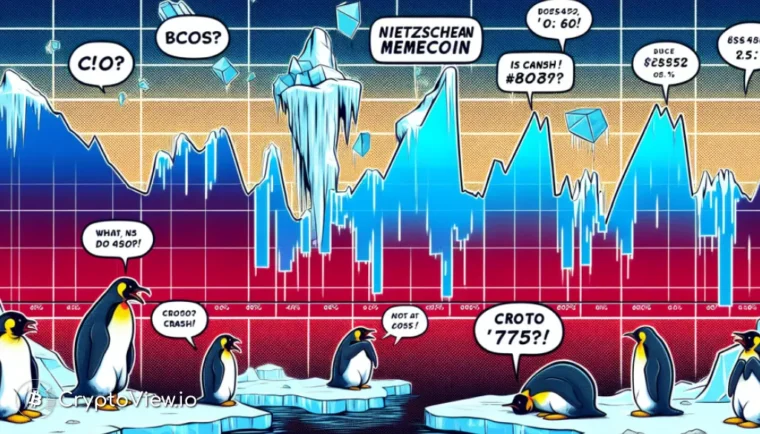
Despite hitting an all-time high near $0.167, the Nietzschean Penguin memecoin saw its value plummet by roughly 75% to the $0.037-$0.042 range by February 1, 2026, signaling a significant Nietzschean Penguin crash where even a fixed supply couldn’t save its bulls from a rapid downturn.
The Meteoric Ascent and Sharp Reversal of PENGUIN
The journey of Nietzschean Penguin (PENGUIN) was a textbook example of memecoin volatility. Launched with notably thin liquidity, the token experienced an explosive surge, rocketing from under $0.01 to an all-time high near $0.167 on January 24th, 2026. This rapid ascent unfolded over mere days, fueled by intense speculative interest and concentrated flows rather than sustained organic demand. Early price discovery was minimal, giving way to a momentum-driven rally that captured significant market buzz.
However, as quickly as it rose, the buying pressure dissipated. Shortly after reaching its peak, the market began to see significant distribution. The token’s price swiftly rolled over, breaking crucial support levels at $0.086 and $0.07. This confirmed a structural shift from bullish momentum to bearish control. Selling intensity escalated as liquidity thinned further, pushing PENGUIN into a deep correction, ultimately trading around $0.037–$0.042, marking a steep 75% drawdown from its peak. On-chain metrics showed the Relative Strength Index (RSI) trending towards oversold territory, suggesting selling exhaustion rather than an imminent reversal, while volatility remained exceptionally high, underscoring the inherent risks.
Whale Accumulation Overwhelmed by the Nietzschean Penguin Crash
The intense sell-off surrounding PENGUIN wasn’t without its casualties, even among large holders. One notable whale, identified by the wallet address “8cgRT,” embarked on an aggressive accumulation strategy, amassing a total of $305,300 worth of PENGUIN tokens. These transactions, executed through repeated buys across platforms like Meteora, Pump.fun, and OKX routes approximately six to seven days prior to the peak, indicated a strategy of aggressive averaging rather than a single, high-conviction entry.
Despite this significant investment, the market’s deterioration proved too powerful. As PENGUIN’s price continued its sharp decline, liquidity evaporated, leading to increased slippage for large trades. The whale ultimately exited their position in a single sweep, realizing $210,700 and locking in a substantial loss of $92,700. This outcome highlighted the severe timing risk inherent in volatile memecoin markets, where accelerating sell pressure can quickly overwhelm short-term liquidity and invalidate even well-capitalized accumulation narratives. The swift Nietzschean Penguin crash served as a stark reminder that even deep pockets can’t always defy market forces.
Why Scarcity Alone Isn’t a Bull Market Guarantee
A key characteristic of Nietzschean Penguin is its fixed supply of 1 billion tokens, with approximately 999.98 million already in circulation. This structure effectively eliminates dilution risk, theoretically leaving the token’s price fully exposed to demand dynamics. Indeed, early momentum pushed the holder count beyond 45,000 by late January 2026, reflecting the viral attention the project garnered. During this period, the price soared, and trading volume briefly exceeded $500 million, signaling peak speculative intensity.
However, the PENGUIN saga demonstrates that scarcity, while important, isn’t a silver bullet for sustained value appreciation. As the initial hype began to fade, holder growth slowed significantly, and profit-taking emerged as a dominant force. The price retraced sharply, often falling faster than holders exited, a familiar pattern in the memecoin space. While the Nietzsche-themed narrative provided a strong hook for short-term engagement, the underlying market structure ultimately dictated the outcome. Without tangible utility beyond speculation, volatility remains exceptionally high. Narrative strength can fuel bursts of attention, but structural weaknesses inevitably lead to deep corrections once speculative flows reverse.
Beyond Hype: The Search for Sustainable Value
The rapid rise and subsequent Nietzschean Penguin crash serve as a potent case study in the memecoin market. While the allure of quick gains and viral narratives can drive incredible short-term price action, the absence of fundamental utility and robust market structure often leads to equally dramatic corrections. For investors navigating this volatile landscape, understanding the difference between hype-driven momentum and sustainable growth is paramount.
As the crypto market matures, the focus increasingly shifts towards projects offering genuine innovation, technological advancements, or real-world applications. While memecoins will likely continue to capture speculative interest, their long-term viability remains tied to their ability to evolve beyond pure narrative. Tools that provide deep market insights and on-chain analytics can be invaluable for discerning genuine trends from fleeting fads. For those looking to track market movements and identify potential opportunities, applications like cryptoview.io offer comprehensive data to help make informed decisions. Find opportunities with CryptoView.io


