
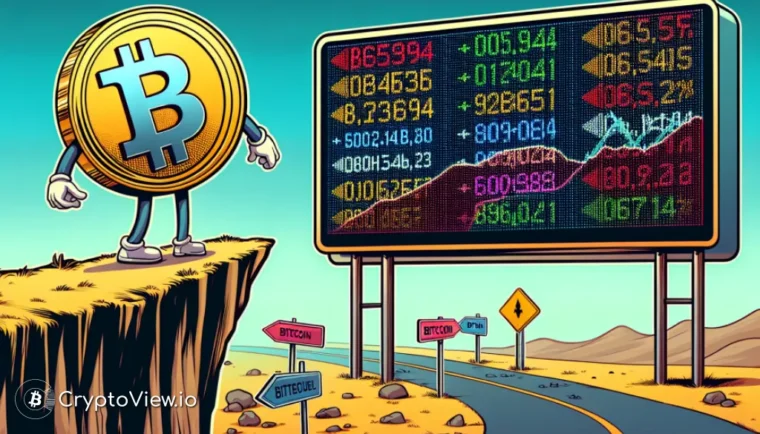
Despite a staggering $843.6 million in U.S. spot Bitcoin ETF inflows on January 14, Bitcoin found itself stalled near the $97,000 mark, failing to break key resistance levels. This surprising market behavior has left many investors pondering the immediate future, prompting a renewed focus on the latest Bitcoin price prediction to gauge its next significant move.
Price of Bitcoin (BTC)
The Curious Case of Stalled Momentum
On January 14, 2026, the crypto market witnessed a peculiar dynamic: substantial institutional interest, evidenced by the impressive $843.6 million in net inflows into U.S. spot Bitcoin ETFs, yet Bitcoin’s price momentum faded. After opening the week with three consecutive days of gains exceeding 2%, the digital asset reached an intraday peak just above $97,000 before trending downward to an intraday low of $95,411. This cooling price action occurred even as political tensions, which historically might have triggered a “flight to safety” into assets like Bitcoin, intensified.
Earlier in the week, on January 13, the market had indeed experienced a significant rally, with Bitcoin surging nearly 5%. This surge was fueled by $754 million in inflows combined with the U.S. Supreme Court’s decision to defer a ruling on reciprocal tariffs, creating what many described as a “perfect storm” for bullish sentiment. However, the failure to decisively breach the $98,000 resistance level seemed to put the brakes on further upward movement, suggesting that while institutional money is flowing in, other factors are at play, creating a ceiling for immediate price appreciation.
Unpacking Institutional Demand vs. Market Action
The disconnect between robust institutional demand and Bitcoin’s price stagnation has become a central point of discussion among market observers. Typically, such significant inflows into ETFs are seen as a strong bullish signal, indicating growing mainstream adoption and confidence. Yet, the price action suggested a more nuanced reality, where external market forces and existing resistance levels held sway. The market’s inability to push past the previous day’s peak of $97,797, despite fresh capital, highlights the complexity of Bitcoin’s current trading environment.
This situation echoes the broader market sentiment following the U.S. Department of Justice’s (DOJ) subpoena of the Federal Reserve, a move that sparked a national debate over the central bank’s independence. While this legal maneuver initially ignited a bullish sentiment, the subsequent failure to test higher resistance levels suggests that political and economic uncertainties are creating a cautious atmosphere. Traders, it seems, are exercising diamond hands but also watching for clear catalysts to push past current consolidation zones.
Charting the Path Ahead: A Fresh Bitcoin Price Prediction
Despite the recent consolidation, many analysts maintain a bullish long-term outlook for Bitcoin, provided it holds above critical support levels. As observed in late 2025, Bitcoin was seen to be gradually emerging from a prolonged consolidation phase that had begun in mid-November of that year. The absence of a sharp, parabolic burst of activity at that time was interpreted as a healthy pause, indicating a more sustainable ascent rather than an overheated market. This scenario often informs a nuanced Bitcoin price prediction, favoring steady growth over volatile spikes.
Weeks prior to our current date of January 15, 2026, some analysts had projected Bitcoin could soon achieve the $100,000 to $105,000 range. While that immediate target has not yet been definitively breached, the underlying market structure, according to on-chain metrics, remains resilient above the $95,000 support. Should demand persist and strengthen, a more ambitious target of $140,000 is still considered a possibility later in 2026. This long-term Bitcoin price prediction hinges heavily on continued institutional adoption and a favorable macroeconomic environment.
Trend of Bitcoin (BTC)
Key On-Chain Indicators and Future Outlook
Beyond price action and ETF flows, on-chain metrics offer valuable insights into market health. Current funding rates and open interest, hovering near $65 billion, are not at “extreme” levels. This suggests that the market is not excessively overleveraged, which is often a precursor to significant liquidations and price corrections. This balanced state indicates a degree of stability, allowing for organic price discovery rather than speculative froth.
However, caution remains prudent. A failure to hold the crucial $95,000 support level could trigger a pullback. Analysts point to the $88,000–$90,000 range as a zone with significant buyer liquidity, where a bounce could be expected. This area would represent a healthy correction, potentially attracting new capital from those waiting to buy the dip. For those looking to navigate these complex market dynamics and identify potential entry or exit points, platforms like cryptoview.io offer comprehensive tools for analysis. Find opportunities with CryptoView.io


