
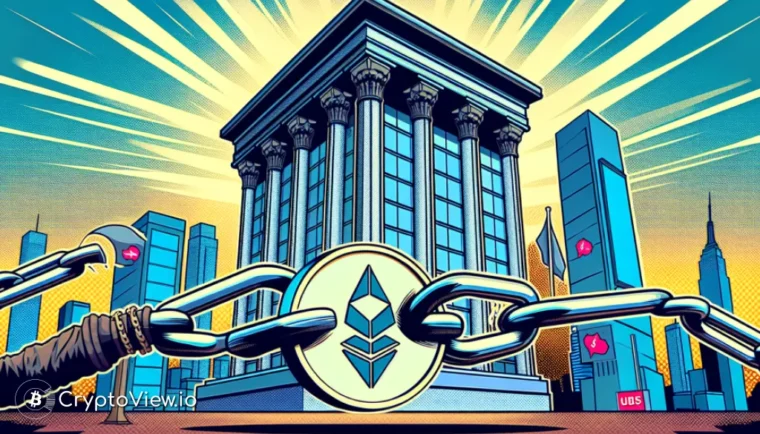
In a landmark move for institutional blockchain adoption, UBS, a financial titan managing over $6 trillion, successfully executed the world’s first live tokenized fund transaction utilizing Chainlink’s Digital Transfer Agent (DTA) standard. This pioneering UBS Chainlink Tokenized Fund demonstrated the viability of complex fund operations on-chain, even as Chainlink’s native token, LINK, was observed grappling with significant resistance levels around the $17 mark in prior market cycles.
Price of Chainlink (LINK)
UBS’s Landmark Leap into On-Chain Finance
UBS’s recent completion of the world’s first live tokenized fund transaction, powered by Chainlink’s Digital Transfer Agent (DTA) standard, represents a monumental stride in integrating blockchain technology into traditional finance. This isn’t just a proof-of-concept; it’s a real-world application proving that intricate fund operations, from share issuance to redemption, can be seamlessly managed entirely on-chain under actual market conditions. For a financial institution of UBS’s caliber, managing over $6 trillion in assets, this move underscores a serious commitment to blockchain’s transformative potential.
This strategic shift for UBS goes beyond mere technological adoption; it aims to modernize fund operations comprehensively. By digitizing processes that traditionally relied on manual reconciliation and numerous intermediaries, UBS is setting a new benchmark. The benefits are clear: instant settlement, automated compliance, fully auditable transactions, reduced operational risks, streamlined workflows, and significantly lower costs. This initiative is designed to enable faster, more secure cross-border transactions, ultimately benefiting both institutional and private clients.
The Power of the UBS Chainlink Tokenized Fund Standard
What makes Chainlink’s DTA standard so pivotal in this evolution? It acts as a crucial bridge between the established world of traditional finance and the innovative realm of decentralized technologies. The DTA standard is meticulously designed to ensure regulatory compliance while simultaneously delivering the inherent advantages of on-chain transactions: speed, transparency, and efficiency. This dual focus is key to unlocking broader institutional adoption.
By providing a framework that adheres to legal requirements while leveraging blockchain’s capabilities, Chainlink empowers fund managers to execute tokenized funds at scale without compromising on essential safeguards. This capability effectively dismantles a significant barrier that previously hindered large-scale institutional participation in the digital asset space. The successful implementation by UBS validates Chainlink’s vision for a tokenized future, where financial assets are seamlessly managed on decentralized networks.
LINK’s Past Market Dynamics: A Battle at Resistance
Around the time of UBS’s groundbreaking announcement, Chainlink’s native token, LINK, was navigating a challenging market environment. On-chain metrics and market buzz from that period indicated persistent bearish pressure, with LINK struggling to break through key resistance levels. Specifically, the $17 to $17.5 zone proved to be a formidable barrier, consistently rejecting recovery attempts and turning what might have been a support area into a strong overhead resistance.
Technical patterns observed during that phase, such as a series of lower highs, signaled weakening buyer momentum. Each rally was met with significant selling pressure, preventing LINK from reaching prior peaks and stalling any potential bullish momentum. This diminishing investor appetite often foreshadowed further declines, as sellers consolidated their control over the market. LINK’s inability to firmly hold the $17–$17.5 recovery zone highlighted the market’s heightened sensitivity, where even minor news could trigger sharp moves amidst prevailing bearish sentiment, with the token trading around $15.73 at one point.
Trend of Chainlink (LINK)
Chainlink’s Expanding Ecosystem and Future Horizons
Despite the historical market struggles of its native token, Chainlink’s underlying technology and ecosystem have continued to demonstrate robust growth. An on-chain analytics firm, Santiment, previously reported that Chainlink had significantly strengthened its lead in DeFi development, further distancing itself from competitors. This continuous innovation in its core offerings, coupled with strategic institutional integrations, paints a compelling picture for the network’s long-term trajectory.
The successful deployment of the UBS Chainlink Tokenized Fund is more than just a win for UBS; it’s a powerful endorsement of Chainlink’s infrastructure and its potential to revolutionize global finance. As more traditional financial giants explore tokenization and blockchain integration, Chainlink’s role as a secure, reliable, and compliant oracle network becomes increasingly critical. This ongoing institutional adoption could very well serve as a catalyst for future growth, reinforcing Chainlink’s position at the forefront of the Web3 economy.
For investors and enthusiasts looking to stay ahead in this rapidly evolving landscape, understanding these foundational shifts is paramount. Tracking significant developments and their impact on digital assets is made easier with comprehensive tools. Discover crypto insights with CryptoView.io


