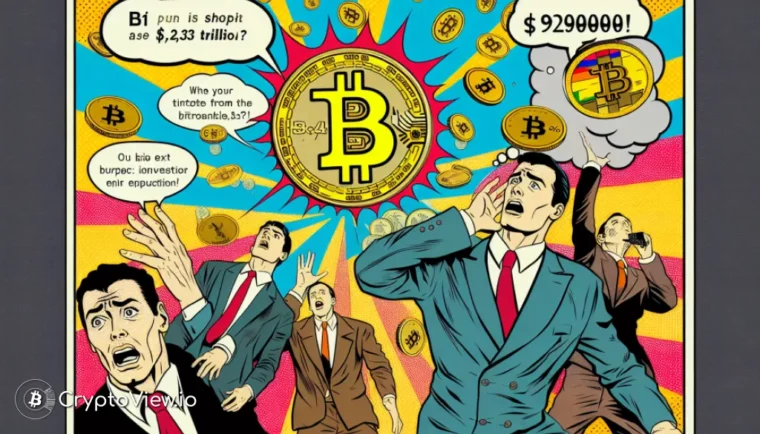
On January 19, 2026, Bitcoin plunged to $92,000, dragging the broader crypto market down 2.5% to a $3.23 trillion capitalization, following U.S. President Donald Trump’s imposition of a surprise 10% tariff on eight European nations. This immediate market reaction clearly illustrates the direct Trump tariffs crypto impact, as investors sought safety amidst escalating global trade tensions.
Price of Bitcoin (BTC)
Global Markets Reel Amidst Trade War Fears
The announcement of new tariffs, targeting European nations that opposed Washington’s stance on Greenland, sent immediate shockwaves across traditional financial markets. Investors globally reacted with apprehension, sparking a flight to safety that saw gold and silver climb to new all-time highs. The fear of a renewed transatlantic trade war quickly permeated trading floors.
Asian markets were among the first to register the fallout. Tokyo’s Nikkei 225 saw a significant dip of 1.4%, with export-reliant sectors taking the brunt. Hong Kong’s Hang Seng also slipped, shedding 0.8%. Interestingly, mainland China’s markets showed resilience, with the Shanghai Composite Index recovering to a 0.3% gain, bolstered by robust fourth-quarter 2025 GDP figures that slightly surpassed forecasts. South Korea’s KOSPI, however, defied the regional trend, surging 1.32% thanks to strong performances from semiconductor giants like Samsung and Micron, signaling investor confidence in the chip sector’s ability to weather broader economic uncertainty.
The Digital Asset Downturn: Unpacking the Trump Tariffs Crypto Impact
The turbulence wasn’t confined to traditional equities and commodities; the digital asset space felt the squeeze just as acutely. Bitcoin, often seen as a bellwether for broader market sentiment in the crypto sphere, experienced a sharp decline late on Sunday, dropping below the critical $92,000 mark. This sell-off triggered hundreds of millions in liquidations across the derivatives market, reflecting a swift shift in trader sentiment.
The broader cryptocurrency market mirrored Bitcoin’s descent, with the total market capitalization contracting by 2.5% to $3.23 trillion. This immediate negative price action highlights how interconnected the crypto ecosystem has become with macro-economic and geopolitical events. While some crypto proponents might advocate for its role as a hedge against traditional market volatility, recent events suggest that major global shocks can still exert significant downward pressure on digital assets. For many traders, this was a moment to practice *diamond hands* and HODL, while others scrambled to de-risk their portfolios.
Europe’s Firm Stance and Retaliatory Pathways
The European nations targeted by Trump’s tariffs – France, the United Kingdom, the Netherlands, Denmark, Germany, Sweden, Norway, and Finland – were quick to signal their collective resolve. The tariffs were a direct consequence of their unified opposition to the U.S. President’s Greenland takeover threat, a move Trump vehemently denounced, particularly criticizing European military deployments to the region. He warned of potential tariff escalations to 25% if Europe didn’t back down, though he hinted at negotiations with Denmark should it concede to U.S. demands.
In response, reports indicate that European Union leaders are actively formulating a multi-billion dollar retaliatory tariff package. Furthermore, they are weighing the activation of the Anti-Coercion Instrument (ACI), a legal and trade defense mechanism adopted in 2023. The ACI’s arsenal includes a range of countermeasures such as additional tariffs, duties, market access restrictions, and even the suspension of cooperation agreements. This signals Brussels’ readiness to meet Washington’s economic pressure with equivalent force, escalating the potential for a full-blown trade dispute. The automotive sector in Europe, particularly German giants like Volkswagen, BMW, and Mercedes-Benz, bore the heaviest losses in early trading, tumbling between 2.5% and 4%, reflecting acute anxiety over tariffs hammering Europe’s vital auto industry.
Trend of Bitcoin (BTC)
Navigating Volatility: What’s Next for Investors?
As global leaders prepare for contentious discussions at the World Economic Forum in Davos, Switzerland, the diplomatic fault lines are deepening. The days leading up to and during the summit are expected to be marked by heightened rhetoric, strategic maneuvering, and continued market anxiety. Investors, both in traditional and digital assets, are closely monitoring developments, seeking clarity on the potential trajectory of international trade relations. The unfolding scenario serves as a stark reminder of how geopolitical tensions can rapidly translate into market volatility, affecting everything from sovereign bonds to altcoins.
Understanding these complex interdependencies is crucial for informed decision-making. Tools that offer real-time market insights and analytics, like cryptoview.io, can be invaluable for investors looking to make sense of the market’s movements and identify potential opportunities amidst the uncertainty. As the dust settles from the initial Trump tariffs crypto impact, careful analysis of on-chain metrics and macroeconomic indicators will be paramount for charting a course through these turbulent waters. Find opportunities with CryptoView.io