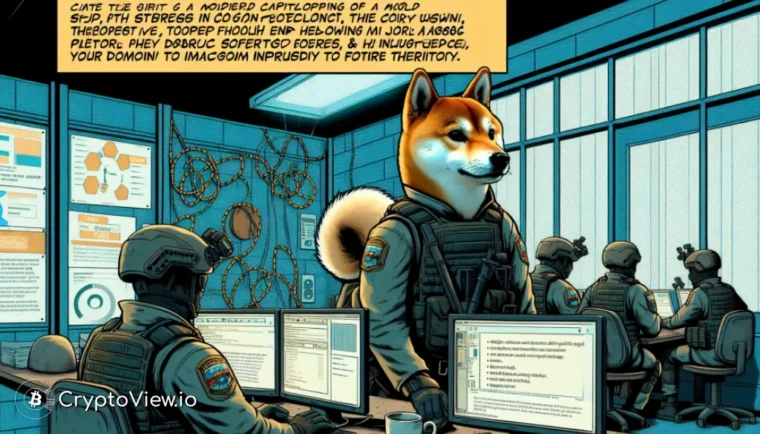
Following a rigorous ten-day effort, the Shiba Inu development team successfully completed the Shibarium bridge recovery, restoring integrity after a major exploit. This monumental undertaking involved safeguarding assets, implementing robust security upgrades, and introducing new preventive measures to fortify the network against future threats.
Price of Shiba Inu (SHIB)
Unpacking the Shibarium Bridge Exploit
The Shiba Inu blockchain recently faced one of its most formidable challenges when attackers targeted the Shibarium Bridge. Lead developer Kaal Dhairya confirmed in a detailed update that the incident was contained, assets were safeguarded, and the network significantly reinforced. The exploit was executed through a series of three fake checkpoints submitted to Shibarium’s Ethereum contracts, effectively disrupting the communication between Heimdall’s local state and its on-chain state, leading to an intentional system halt.
Further complicating matters, the attacker attempted to manipulate validator thresholds by staking 4.6 million BONE tokens. This combination of checkpoint manipulation and stake amplification posed a critical risk, demanding immediate and decisive intervention from the development team to prevent further compromise and ensure the network’s long-term stability. The community watched closely, with many holding their tokens with *diamond hands* as the team worked tirelessly.
The Ten-Day Battle for Restoration
In response to the crisis, the Shiba Inu core team, alongside external partners, embarked on an intensive, round-the-clock effort that spanned over ten days. Dhairya highlighted the extraordinary commitment, noting that developers worked late nights, weekends, and even through holidays to mitigate risks and fully restore security. To manage the complex situation, the response was strategically divided into overlapping workstreams. Cybersecurity firm Hexens.io was engaged as an independent reviewer, mirroring the team’s testing protocols and providing crucial sign-offs on each fix implemented. Multiple daily standups, emergency syncs, and continuous log reviews were conducted to ensure no detail was overlooked, emphasizing a meticulous approach to problem-solving.
Crucially, responsibilities were meticulously separated across distinct owners for infrastructure, validator operations, test networks, and monitoring. This compartmentalized structure was designed to minimize potential points of failure, allowing for parallel progress while maintaining stringent oversight and ensuring every component of the system was thoroughly secured. This collaborative and structured approach was vital for the swift and effective Shibarium bridge recovery.
Fortifying the Network: New Security Measures
Following the successful containment of the exploit, the team wasted no time in introducing several robust measures to harden Shibarium against any future attacks. These enhancements were rigorously rehearsed on Devnet and Puppynet before being deployed to the Mainnet, ensuring stability and effectiveness.
- Multi-Signature Wallet Migration: Over 100 critical contracts across Shibarium, ShibaSwap, and the Shiba Inu Metaverse were migrated to secured multi-signature wallets. This crucial step ensures that no single entity can control mission-critical assets, significantly reducing centralized risk.
- Validator Key Rotation: All validator signing keys were rotated. By replacing keys tied to the compromised state, developers established stronger custody rules and effectively isolated the network from previous exposure.
- Blacklist Feature for Staking: A new blacklist feature was integrated into staking operations. This mechanism empowers the system to immediately block malicious addresses from staking, unstaking, withdrawing rewards, or re-bonding funds, adding a proactive layer of defense.
One of the most significant achievements during the recovery was the successful rescue of 4.6 million BONE tokens that had been linked to the attacker. Since these tokens were staked through a contract rather than an external wallet, the team devised a targeted recovery method. Through the StakeManager, developers executed new procedures that corrected legacy unbonding data and restored ledger integrity. This action led to the removal of the malicious delegation and the secure recovery of the tokens. Concurrently, the withdrawal delay was extended from one checkpoint to approximately 30 checkpoints, roughly 24 hours, providing the team ample time to detect unusual activity before withdrawals are finalized.
Trend of Shiba Inu (SHIB)
Looking Ahead: Roadmap and User Protection
The Shiba Inu team has outlined a careful roadmap for progressively restoring full bridge functionality. A blacklist mechanism is slated for integration into the Plasma Bridge, which will proactively prevent malicious addresses from initiating transactions. Once this critical safeguard is fully operational, the Plasma Bridge’s functionality will be gradually brought back online, ensuring a secure and stable environment for users.
Moreover, the development team is actively formulating a comprehensive plan to ensure that all affected users are fairly compensated. This process is expected to involve phased withdrawals, strict transaction limits, and close coordination with various partners to manage the distribution seamlessly and securely. Developers have emphasized that specific timelines will only be communicated when it is absolutely safe to do so, prioritizing operational security over premature announcements. For those keen on tracking these developments and other market trends, tools like cryptoview.io can offer valuable insights into the dynamic crypto landscape. Find opportunities with CryptoView.io
Beyond immediate recovery efforts, Shibarium is also bolstering its long-term resilience through strategic infrastructure improvements. The team has forged a partnership with dRPC.org to consolidate RPC services under a unified endpoint: rpc.shibarium.shib.io. This move is anticipated to significantly enhance reliability and streamline access for developers. Furthermore, a comprehensive overhaul of the project’s documentation is underway. By simplifying node setup and validator instructions, the team aims to encourage broader community participation while simultaneously elevating the overall security baseline across the entire Shibarium ecosystem.