
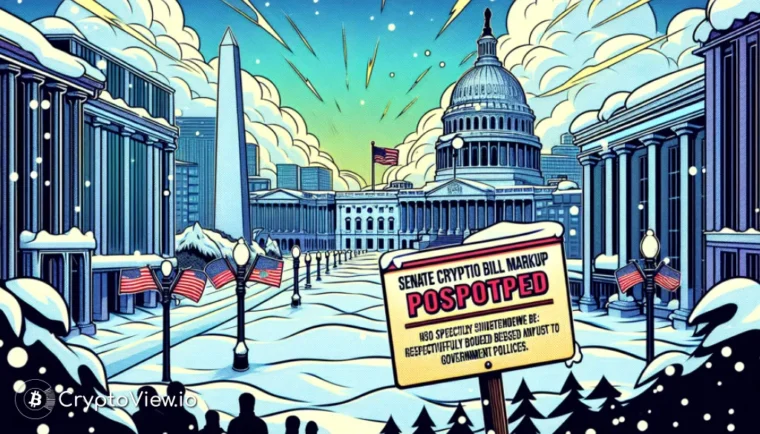
A significant snowstorm in Washington D.C. recently caused a two-day postponement for the highly anticipated Senate Crypto Bill Markup by the Senate Agriculture Committee. Originally slated for Tuesday, the markup was rescheduled for Thursday, January 23, 2026, amid concerns over a lack of bipartisan support and the looming threat of a federal government shutdown, adding layers of complexity to the already intricate legislative process for digital assets.
The Initial Delay and Lingering Obstacles
The journey for comprehensive crypto legislation in the U.S. Senate continues to hit snags. A recent snowstorm forced the Senate Agriculture Committee to delay its crucial vote on a crypto market structure bill, pushing it back to Thursday, January 23rd. While weather-related delays are common, this postponement highlighted deeper issues plaguing the bill’s progress. The proposed legislation, which aims to clarify regulatory oversight for digital assets, has struggled to garner broad consensus, particularly from Democratic senators, raising questions about its viability in a divided Congress.
Beyond the immediate weather challenges, the bill faces formidable hurdles. A potential federal government shutdown, a recurring theme in recent months, loomed over Washington, threatening to sideline legislative efforts, including those for digital assets, as lawmakers divert attention to budget negotiations. This constant political uncertainty creates a volatile environment for crypto policy, leaving many in the industry with *diamond hands*, hoping for clarity.
The Bipartisan Dream Deferred
For months, members of both parties on the Agriculture Committee had been working to craft a bipartisan framework for the crypto bill. This committee, which oversees the Commodity Futures Trading Commission (CFTC), is responsible for the portions of the legislation dealing with commodities. Meanwhile, the powerful Senate Banking Committee, tasked with overseeing the Securities and Exchange Commission (SEC), handles the sections related to securities law and traditional banking. The hope was that a unified front from Agriculture could build momentum.
However, that bipartisan ideal recently faltered. Senator John Boozman (R-AR), chair of the Agriculture Committee, ultimately decided to move forward with a key vote despite a clear absence of Democratic buy-in. Boozman acknowledged that “differences remain on fundamental policy issues,” signaling a significant rift. Crypto market buzz suggests that many observers believe the bill was “99% likely” to receive zero Democratic support at the Thursday markup, which could be a significant setback for a bill initially championed as a bipartisan effort.
Political Pressures and Looming Deadlines
The decision to proceed with a potentially partisan vote on the Senate Crypto Bill Markup could prove counterproductive. While the bill might technically pass through the Agriculture Committee on party lines, such an outcome could undermine its chances on the broader Senate floor, where Democratic votes would be essential for passage. This echoes a previous incident where the Senate Banking Committee abruptly canceled its own crypto markup, partly due to crypto giant Coinbase’s last-minute withdrawal of support over a dispute with the banking lobby—a thorny issue that remains unresolved.
Adding to the legislative pressure cooker, former President Donald Trump had expressed his hopes on January 21, 2026, that he would sign a crypto market structure bill “very soon,” during a speech at the World Economic Forum in Davos. His comments, mentioning “Bitcoin, all of them,” were likely intended to inject urgency into the legislative process. However, the overarching deadline for the crypto industry to secure significant legislation is widely considered to be spring 2026, before the focus shifts entirely to preparations for November’s midterm elections, which typically grind congressional activity to a halt.
Navigating the Path Forward for Digital Asset Legislation
The confluence of a partisan divide, the unresolved banking lobby tussle, and the constant threat of government shutdowns creates a challenging environment for crypto legislation. The recent killing of a civilian in Minneapolis by federal law enforcement further complicated budget negotiations, making another government shutdown — potentially the second in four months — a distinct possibility. Such an event would undoubtedly push crypto-related votes further down the legislative calendar and potentially off lawmakers’ priority lists entirely.
For investors and enthusiasts, tracking these legislative developments is paramount, as regulatory clarity can significantly impact market sentiment and asset valuations. Keeping an eye on on-chain metrics and political shifts provides crucial insights. Tools that offer comprehensive market analysis and legislative tracking, like cryptoview.io, can be invaluable for navigating these complex waters. Find opportunities with CryptoView.io


