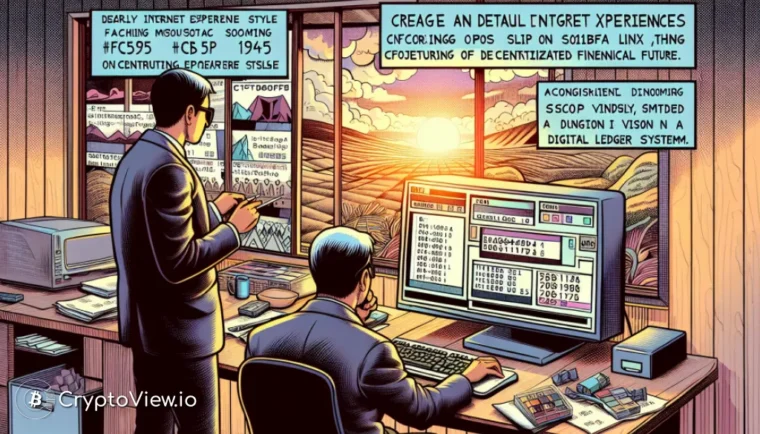
Ripple CTO David Schwartz recently revealed his foundational interactions with the internet, recalling the intricate process of editing DOS startup files to load packet drivers and configuring SLIP on SLS Linux. These deep technical roots in the early digital frontier significantly shaped his understanding, ultimately influencing the Ripple CTO internet origins of the XRP Ledger’s architecture and its vision for a decentralized financial future.
Price of XRP (XRP)
Tracing the Digital Roots of a Crypto Visionary
In a recent online discussion, a prominent product head sparked a wave of nostalgia by asking followers for their earliest memories of the internet. Among the myriad responses, Ripple’s Chief Technology Officer, David Schwartz, offered a glimpse into his profound early experiences, which went far beyond simple browsing. His recollections paint a vivid picture of a nascent digital world, where connectivity was a hard-won battle, not a given.
Schwartz detailed a hands-on journey, involving:
- Manually editing DOS startup files to load critical packet drivers.
- The painstaking process of configuring SLIP (Serial Line Internet Protocol) on SLS Linux, which often required juggling up to 14 floppy disks.
- Memorizing complex bang paths, a form of addressing used in early Unix-like systems for routing email and other network traffic across multiple machines.
These experiences highlight an era where understanding the underlying mechanics of network communication was essential for simply getting online. This deep, practical knowledge of how information traversed digital pathways would later become instrumental in his pioneering work in blockchain and digital assets.
From Packet Drivers to the XRP Ledger
It’s fascinating to consider how these foundational Ripple CTO internet origins directly informed the creation of the XRP Ledger (XRPL). Schwartz, along with Jed McCaleb and Arthur Britto, embarked on the journey to build a more efficient and scalable distributed ledger in 2011, officially launching it in June 2012. Their aim was clear: to overcome the inherent limitations observed in early blockchain iterations, particularly Bitcoin’s transaction speed and energy consumption.
The XRP Ledger was designed from the ground up to be a superior alternative for value exchange, much like how the internet revolutionized information exchange. Its native cryptocurrency, XRP, was envisioned to facilitate rapid, low-cost international payments. This vision was a direct outgrowth of understanding how systems could be optimized for speed and reliability, drawing parallels to the meticulous optimization required for early internet connections.
The Internet of Value: Web3’s Evolution
The parallels between the internet’s evolution and the rise of blockchain technology are undeniable. Just as the internet transformed how we share information, cryptocurrencies and blockchain are reshaping the exchange of value, giving rise to what many term the Internet of Value. This movement, born partly from the aftermath of the 2008 financial crisis, aimed to create a more equitable and efficient financial system for everyone, not just traditional institutions.
Web3, often described as the next iteration of the internet, is intrinsically linked to this vision. It proposes a decentralized web, where blockchain technology forms the backbone, enabling a myriad of new use cases for digital assets. From decentralized finance (DeFi) to non-fungible tokens (NFTs) and decentralized autonomous organizations (DAOs), Web3 is expanding the horizons of what’s possible, moving beyond mere information to verifiable ownership and programmable value. The market buzz around these innovations suggests a future where digital assets are as ubiquitous as digital information.
Trend of XRP (XRP)
Pioneering Institutional DeFi on XRPL
Looking ahead, the XRP Ledger continues to evolve, with its updated institutional DeFi roadmap setting the stage for significant advancements. This strategic direction focuses on two pivotal themes that are shaping XRPL’s institutional DeFi landscape in the coming months:
- Native Lending Protocol Launch: The introduction of a native lending protocol aims to enhance liquidity and enable new financial instruments directly on the XRPL, attracting institutional players seeking robust and transparent DeFi solutions.
- Zero-Knowledge Proofs (ZKPs) Integration: The integration of ZKPs for privacy with accountability is a game-changer. It allows for transactions to be verified without revealing underlying sensitive information, a crucial feature for institutional adoption where regulatory compliance and data confidentiality are paramount.
These developments underscore a commitment to building a resilient and versatile ecosystem capable of meeting the complex demands of institutional finance. For those looking to stay on top of these rapidly evolving market dynamics and track digital asset performance, tools like cryptoview.io offer comprehensive insights. Staying informed is key to navigating this exciting, yet volatile, space.