
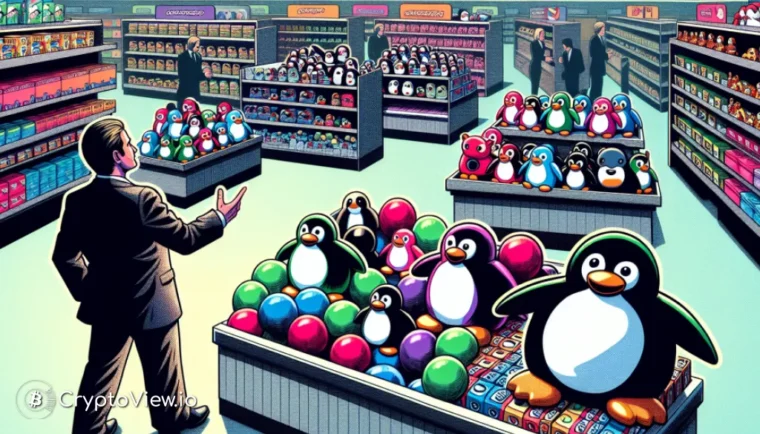
Pudgy Penguins, an NFT collection boasting a market capitalization of approximately 47,000 ETH (around $159 million) as of late 2025, is strategically expanding its presence beyond the digital realm. By tapping into the expertise of seasoned toy industry veteran Steve Starobinsky, the project is meticulously executing its Pudgy Penguins retail strategy to transition from a crypto-native phenomenon to a mainstream consumer brand.
The Architect of Mass Market Appeal
Steve Starobinsky, with decades of experience in the toy manufacturing world, was brought on board in March 2025 to refine Pudgy Penguins’ approach to consumer packaged goods. His role as Director of Business Development and Partnerships demands a methodical strategy, a stark contrast to the rapid, often reactionary “sprints” common in crypto. Starobinsky emphasizes that securing shelf space in major retailers requires significant lead times. For instance, purchase orders for the 2026 holiday season were already finalized in September 2025, underscoring the necessity of long-term planning. Missing these critical cycles means missing out on major retail opportunities for the subsequent year.
Bridging the Digital and Physical Divide
Since its acquisition by CEO Luca Netz in 2022, Pudgy Penguins has solidified its position as a leading NFT project. Beyond its primary collection, which ranked as the third most valuable overall in late 2025 according to NFT Price Floor, the brand also boasts two other successful NFT collections and the Pengu token on Solana, which had achieved an impressive valuation of around $818 million by late 2025, as reported by CoinGecko. Additionally, a blockchain-based mobile game developed with Mythical Games further diversifies its digital ecosystem. However, the company’s ambitious vision extends firmly into the physical world, leveraging Starobinsky’s deep understanding of the consumer goods landscape.
Current physical product collaborations include partnerships with established names such as:
- Bearbrick
- PEZ
- Penguin Random House (for children’s books)
Starobinsky, who previously contributed to the success of brands like Paw Patrol, Minecraft, and PopSockets, sees immense potential in Pudgy Penguins’ playful, hand-drawn aesthetic to resonate with a broad audience, from children to adults. He believes that *playful brands are dominating pop culture*, a trend he has witnessed firsthand in his career as intellectual properties transition from niche communities to mass market appeal.
A Strategic Play for “Owning Winter”
Pudgy Penguins is no stranger to traditional retail, having launched toys in 2023 with products available in major stores like Walmart, Target, and Walgreens. By October 2025, the company had already generated over $13 million in sales from more than 1 million units. Looking ahead to 2026, a Pudgy spokesperson indicated a target of over $20 million in retail sales, encompassing both licensed and self-sourced products. Starobinsky’s team, comprising six individuals focused on business development, events, and public relations, is instrumental in achieving this ambitious goal.
One of the most innovative aspects of the Pudgy Penguins retail strategy involves capitalizing on what Starobinsky calls the “dead zone” in toy advertising. While most manufacturers scale back marketing efforts after December 26th, Pudgy Penguins, with its winter-themed brand identity, plans to increase advertising during the typically quiet period between the New Year and Valentine’s Day. This counter-cyclical approach aims to:
- Extend the holiday shopping season.
- Secure prime promotional space when competitors are absent.
- Potentially allow retailers to maintain margins rather than resorting to price reductions.
“Whenever you’re building go-to-market strategies, it’s a lot better when you don’t have to ram up against some competition,” Starobinsky had remarked, highlighting the advantage of *attacking white space*. This strategic marketing spend, coupled with strong retailer partnerships, is designed to elevate Pudgy Penguins from achieving millions to hundreds of millions in retail sales.
The Long Game: From Niche to Global Brand
The journey from a digital collectible to a global consumer brand is a marathon, not a sprint. Starobinsky’s approach, honed over years in the toy industry, emphasizes patience and meticulous execution, demonstrating a true *diamond hands* mentality for brand building. He and CEO Luca Netz (Luca Schnetzler) share a history, having worked together at Gel Blaster, where they successfully created a new product category. This shared experience underpins their collaborative vision for Pudgy Penguins. Starobinsky noted that a comprehensive refresh of new retail goods proved challenging in 2025 due to the company’s nascent experience in physical goods, but his efforts for 2026 are expected to be significantly more impactful.
The ambition for the Pudgy Penguins retail strategy is clear: to “own winter” and establish a year-round presence that leverages its unique brand identity. This involves not just selling products, but creating a sustained marketing ecosystem where the brand can consistently engage consumers. For those looking to track the evolving landscape of digital assets and their real-world applications, platforms like cryptoview.io offer invaluable insights into market trends and project developments. Discover market insights with CryptoView.io The integration of digital and physical worlds represents a significant evolution for NFT projects, signaling a maturation of the Web3 space.


