
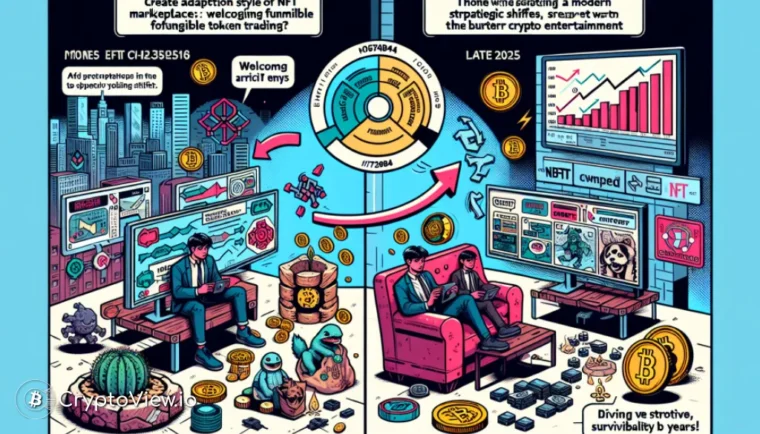
With the cumulative NFT market cap plummeting 99% from its 2023 peak of $184 billion to a mere $487 million by late 2025, major platforms like OpenSea and Magic Eden successfully navigated this crypto winter through significant strategic shifts, demonstrating vital NFT Marketplace Adaptation to survive a rapidly evolving digital asset landscape. This aggressive pivot involved embracing fungible token trading and diversifying into broader crypto entertainment, a stark contrast to the speculative frenzy of earlier years.
The Great Digital Asset Shift: Beyond JPEGs
The days of Beeple’s $69.3 million JPEG sale and celebrity *aping* into Bored Ape Yacht Club are certainly a distant memory. By 2025, the once-booming NFT market had undergone a dramatic transformation, forcing its leading platforms to re-evaluate their core business models. This structural slowdown in pure NFT activity necessitated a broader economic foundation for marketplaces that previously thrived on high-velocity trading of profile picture collections.
James Butterfill, head of research at CoinShares, highlighted this imperative, noting that marketplaces needed to defend their relevance within a maturing digital asset ecosystem. The shift wasn’t just about weathering a downturn; it was about evolving with user demand and the wider crypto economy. This period saw a significant expansion of offerings, moving beyond just non-fungible tokens to include fully fungible digital assets, signaling a clear strategic pivot for long-term viability.
OpenSea’s OS2: A Comprehensive Rebuild
OpenSea, a titan in the NFT space, unveiled a complete overhaul of its platform in February 2025. Dubbed OS2, this reimagined infrastructure integrated cross-chain token trading through its own decentralized exchange (DEX), supporting transactions across an impressive 19 blockchains. The platform also introduced a new rewards system called “Voyages,” which market observers widely speculated would play a pivotal role in the anticipated launch of its SEA token.
Adam Hollander, OpenSea’s CMO, clarified that this move wasn’t a sudden pivot but rather a natural evolution. The company aimed to become a comprehensive trading hub for “whatever people are valuing online,” encompassing digital collectibles, tokenized real-world assets, perpetuals, and prediction markets. While OpenSea’s DEX saw a peak monthly volume of $2.41 billion in October 2025, it subsequently retraced to $581.48 million in November, illustrating the volatility inherent in this expanded trading arena, especially when compared to DEX giants like Uniswap’s nearly $80 billion monthly volume.
Magic Eden’s Foray into Crypto Entertainment
Magic Eden took a different, yet equally strategic, path in its NFT Marketplace Adaptation. While it also embraced multi-chain token trading, even acquiring the meme coin trading app Slingshot in April 2025, its Chief Business Officer, Chris Akhavan, emphasized that token trading wasn’t the platform’s primary focus. Akhavan pointed out the commoditized nature of the token trading market, already saturated with numerous wallets, DEXs, and centralized exchanges.
Instead, Magic Eden set its sights on “crypto entertainment.” Their “Packs” platform, for instance, allows users to open virtual packs containing both real-world assets, like Pokémon cards, and NFTs. This initiative has already generated tens of millions in volume. Furthermore, Magic Eden is building out a broader entertainment ecosystem, with the upcoming launch of Dicey, a crypto casino and sportsbook, slated as a “major new product.” The ambition is clear: to become the “biggest crypto entertainment brand in the world.” CoinShares’ Butterfill noted Magic Eden’s aggressive stance, particularly within Solana-based and gaming ecosystems, positioning it as an “application layer” for digital culture rather than solely an NFT marketplace.
The Future: Cultural Liquidity Hubs
The strategic shifts undertaken by OpenSea and Magic Eden have demonstrably helped stabilize engagement numbers and diversify revenue streams during a year marked by subdued traditional NFT volumes. These adaptations have proven effective, transforming these platforms into more resilient entities within the digital asset landscape. The long-term success of these marketplaces hinges on their ability to offer either structural differentiation or seamless integration between NFT and fungible token rails—a unique value proposition that users cannot easily replicate elsewhere.
Ultimately, both platforms are evolving into cultural liquidity hubs, bridging creators, collectors, and token communities. Their enduring relevance will depend on the continued expansion of these cultural economies and whether users perceive them as essential infrastructure rather than mere optional front-ends. For those keen to track these evolving market dynamics and identify emerging opportunities, tools like cryptoview.io offer invaluable insights into the shifting tides of digital asset trading and cultural trends. Find opportunities with CryptoView.io


