
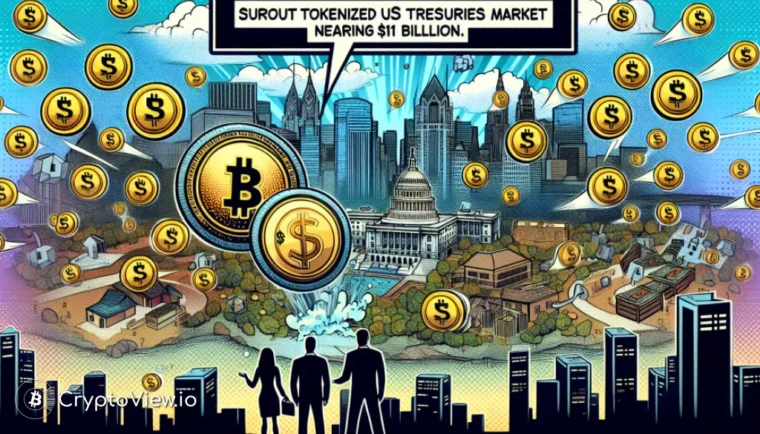
Yes, the Tokenized US Treasuries Market is on the cusp of a significant milestone, currently valued at an impressive $10.86 billion, with year-to-date inflows for 2026 reaching $1.9 billion. This surge highlights a robust demand for real-world assets (RWAs) even as the broader crypto landscape navigates challenging market conditions, underscoring its growing importance in digital finance.
The Steadfast Rise of Digital Treasuries
Amidst a crypto market that has, at times, been *nursing its bruises*, the sector for tokenized U.S. Treasury products has shown remarkable resilience and growth. Recent on-chain metrics from rwa.xyz confirm the sector’s valuation climbing by 2.51% over the past week, placing it tantalizingly close to the $11 billion mark. This consistent influx of capital suggests that investors are increasingly looking to digital assets for stable, yield-bearing opportunities that bridge traditional finance with the decentralized world.
The appeal is clear: tokenized Treasuries offer a blend of stability from government bonds with the efficiency and accessibility of blockchain technology. While the average seven-day annual percentage yield (APY) across the sector saw a slight dip of 16.78% from the prior week, settling at 2.66%, the underlying demand remains strong. The total number of tokenized U.S. bond holders stands at 65,058, a minor adjustment of 0.27% over the same period, indicating a dedicated and growing user base.
Navigating the Blockchain Landscape for Tokenized Assets
The distribution of these digital assets across various blockchains paints an interesting picture of ecosystem preferences and infrastructure capabilities. Ethereum, as expected, remains the dominant chain, hosting a substantial $5.5 billion of the tokenized U.S. Treasury sector’s total value. This speaks volumes about Ethereum’s enduring role as a foundational layer for significant DeFi and RWA initiatives.
Following Ethereum, BNB Chain holds a strong second position with $2.1 billion, showcasing its robust network and growing user base. Solana, known for its high throughput, commands $892.6 million, while Stellar, a network often favored for its payment-centric design, accounts for $829.3 million. Other notable contenders in the Tokenized US Treasuries Market include Aptos ($304.8 million), XRP Ledger ($299.8 million), Avalanche C-Chain ($294.1 million), and Arbitrum ($197.3 million), with a diverse mix of other networks contributing smaller, yet significant, portions.
This multi-chain approach underscores the industry’s drive towards interoperability and accessibility, allowing investors to choose platforms that best suit their operational needs and risk profiles. The variety of chains also fosters innovation, as different protocols compete to offer the most efficient and secure tokenization solutions.
Key Players and Their Impact on Fund Flows
The past month has seen several key players driving significant inflows into the tokenized Treasury space. Blackrock’s BUIDL fund, issued by Securitize, led the charge with an impressive $460 million in net inflows. Ondo’s USDY product also saw substantial interest, pulling in $302 million, closely followed by Circle’s USYC with $251 million.
Other notable contributions came from Superstate’s USTB ($148 million), Centrifuge’s JTRSY ($103 million), Spiko’s USTBL ($37 million), Libeara’s CUMIU ($31 million), and Zeconomy’s DCP ($30 million). These figures highlight a broad institutional and retail appetite for stable, regulated digital asset exposure. However, not all funds saw positive movement; Fidelity’s new tokenized U.S. Treasury fund, FDIT, experienced a $36 million outflow, and Ondo’s OUSG logged $45 million in net redemptions, illustrating the dynamic nature of capital allocation within the sector.
What’s Next for the Tokenized US Treasuries Market?
With the sector firmly entrenched just below the $11 billion threshold, market sentiment suggests this milestone is less a speculative target and more a matter of time. The consistent rotation of capital into tokenized Treasuries reinforces their critical role as a digital extension of traditional fixed-income exposure, a trend that began gathering momentum last year and shows no signs of cooling. If the current trajectory holds, the climb towards — and likely beyond — $11 billion appears to be a procedural step rather than a speculative gamble, potentially setting the stage for even greater adoption.
This sustained growth points to a maturing ecosystem where the line between traditional finance and decentralized finance continues to blur. As more institutions and individual investors seek stable, yield-generating opportunities accessible on-chain, platforms that provide comprehensive market data and analytical tools become indispensable. For those looking to track these movements and identify emerging opportunities, tools like cryptoview.io can offer invaluable insights into the evolving landscape of digital assets and RWAs. Find opportunities with CryptoView.io


