
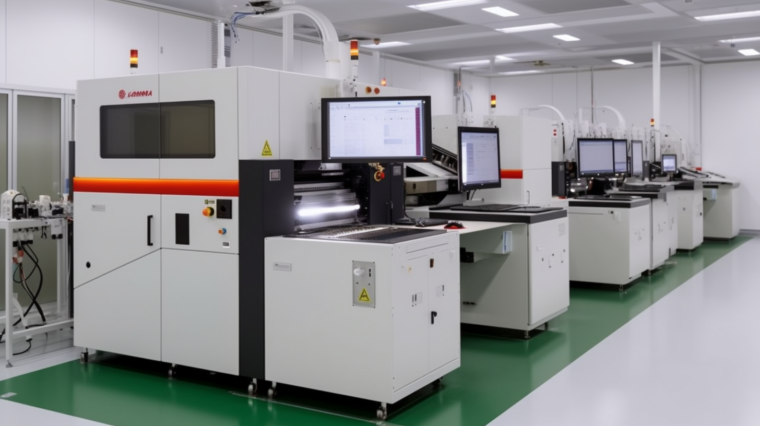
Is Canon’s new technology competing with ASML in chip manufacturing? The Japanese giant, renowned for its cameras and printers, has revealed a ground-breaking solution aimed at propelling the production of advanced semiconductor components to new heights.
A Bold Response to ASML’s Dominance
Canon’s recent unveiling of its ‘nanoimprint lithography’ system is a strategic move to challenge the dominance of the Dutch company ASML, a key player in the extreme ultraviolet (EUV) lithography machine sector. ASML’s technology is integral to the manufacture of high-end chips, such as those found in the latest Apple iPhones. This has put the company’s machinery at the heart of the tech rivalry between the United States and China.
Canon’s New System: A Quantum Leap in Chip Manufacturing
Canon’s newly announced FPA-1200NZ2C system is said to be capable of producing semiconductors at a 5nm process and scaling down to 2nm. This leapfrogs the A17 Pro chip used in Apple’s iPhone 15 Pro and Pro Max, which is a 3nm semiconductor. The nanometer measurement refers to the size of the features on a chip, with smaller figures allowing for more features and thus, superior performance.
Implications for the Global Tech Landscape
The Dutch government has restricted ASML from exporting its EUV lithography machines to China, a country that has yet to receive any units. This is due to the machines’ critical role in the production of advanced semiconductor chips. With Canon’s claim that its new machine can produce semiconductors equivalent to 2nm, it’s likely to come under increased scrutiny.
As we witness these developments in the chip manufacturing industry, staying informed is paramount. For real-time updates and insights, consider using applications like cryptoview.io. Not only can you stay ahead with the latest tech news, but you can also monitor your crypto portfolio and get in-depth analysis of the crypto market.
Stay updated with cryptoview.io

