
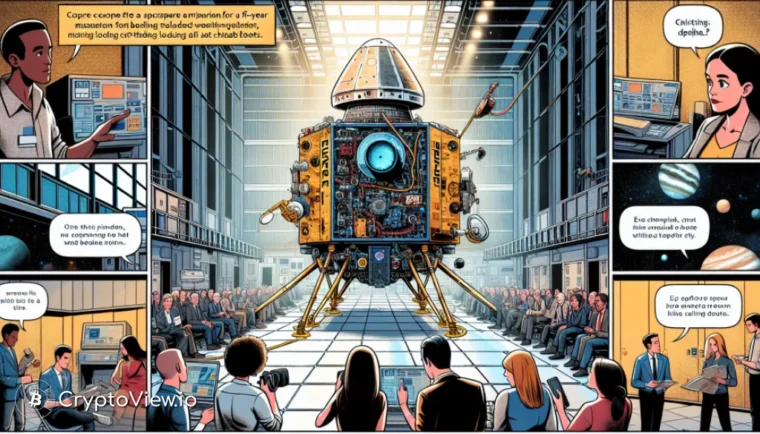
At the heart of NASA’s ambitious journey to Europa, one of Jupiter’s moons, lies the Europa Clipper mission. A mission that, despite its cutting-edge technology, will embark without the inclusion of artificial intelligence (AI) chatbots. This decision highlights the mission’s focus on precision and pre-programmed objectives over the adaptability offered by AI.
Inside the Europa Clipper Mission
The Europa Clipper is slated for a monumental task: to orbit Jupiter and conduct a series of flybys around its icy moon, Europa. Its primary goal is to assess the moon’s habitability by studying its icy surface and subsurface ocean, searching for signs of life, and analyzing its composition and geology. The absence of AI does not diminish the sophistication of the onboard technology, which includes a plethora of instruments designed to perform these complex tasks.
The spacecraft’s design and assembly process is a marvel of engineering. Before being deemed ready for its journey, the Europa Clipper undergoes rigorous testing, including vibration tests to simulate launch conditions. This ensures that all components are secure and functional for the mission ahead. The design of the spacecraft is intentional, catering to the requirements of each scientific instrument while ensuring they can operate without interference from each other.
The Role of AI in Space Exploration
While AI has become a staple in many aspects of space exploration, its role in the Europa Clipper mission is notably minimal. The mission relies on pre-programmed software to operate the spacecraft and its instruments. This approach is necessitated by the vast distance between Earth and Jupiter, which introduces a significant delay in communications. Therefore, the spacecraft must be able to perform its tasks autonomously, without real-time instructions from Earth.
The decision to exclude AI from the Europa Clipper mission underscores a strategic choice: to prioritize reliability and precision over the potential benefits of AI’s adaptability. This choice reflects the mission’s critical objectives and the challenges posed by the deep-space environment.
Engagement and Inspiration
The Europa Clipper mission is not just a scientific endeavor; it’s a source of inspiration and engagement for space enthusiasts and the general public alike. The Jet Propulsion Laboratory (JPL), which manages the mission, offers opportunities for people to learn about and engage with the mission, highlighting the broader impact of space exploration on society.
For those intrigued by the financial aspects of space exploration and beyond, applications like cryptoview.io offer a gateway to explore the economic dimensions of such ambitious projects. By providing insights into the cryptocurrency market, cryptoview.io bridges the gap between space exploration and financial innovation.
Find opportunities with CryptoView.ioIn conclusion, the Europa Clipper mission represents a significant step forward in our quest to understand the cosmos. While AI plays a growing role in space exploration, the decision to proceed without it in this mission highlights the careful planning and specific objectives that guide NASA’s exploration efforts. As we look forward to the launch and the wealth of data the Europa Clipper will gather, we are reminded of the incredible potential for discovery that lies within our solar system and beyond.


