
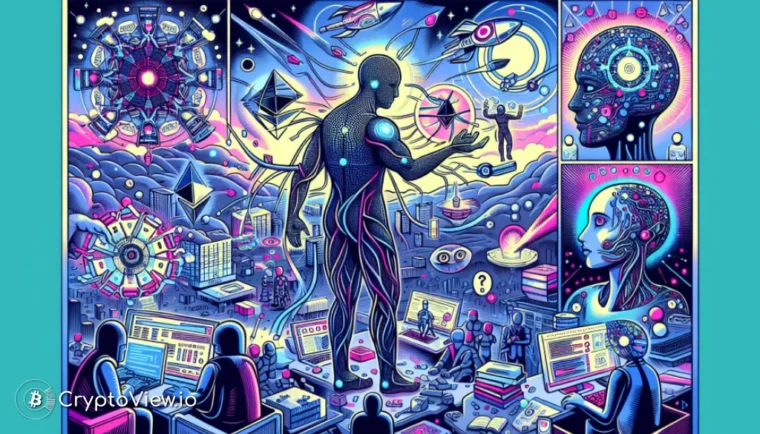
As Ethereum gears up for its anticipated Glamsterdam upgrade in H1 2026, a groundbreaking innovation is on the horizon: the proposed ERC-8004 Ethereum AI Agents standard. This EIP is set to revolutionize the network by making it fully AI-ready, enabling autonomous agents to execute complex economic tasks directly on-chain, thereby ushering in a new era of decentralized intelligence.
Price of Ethereum (ETH)
The Dawn of Trustless Agents on Ethereum
Ethereum, already the leading smart contracts platform, is rapidly evolving to integrate artificial intelligence at its core. The EIP-8004, dubbed ‘Trustless Agents,’ has garnered significant attention, aiming to provide the technical and economic framework for hosting autonomous AI agents. These agents are not merely programs; they are designed to perform sophisticated economic actions, from simple goods ordering to engaging in prediction markets or providing liquidity within DeFi protocols. This move aligns perfectly with Ethereum’s ongoing efforts to enhance scalability and reduce block times, with the Glamsterdam hard fork specifically targeting a three-fold reduction in L1 execution time, pushing towards six-second blocks.
The vision is clear: to create an ‘agentic economy’ where AI entities can operate with unprecedented autonomy and trustlessness. This means AI agents will have their own on-chain identities, reputations, and validation mechanisms, enabling them to interact with smart contracts and other agents in a secure and verifiable manner. The integration of such advanced AI capabilities is expected to unlock a myriad of new decentralized applications (dApps) and services, pushing the boundaries of what’s possible on a blockchain.
Architecting the Agentic Economy: Key Registries for ERC-8004 Ethereum AI Agents
To facilitate this sophisticated agentic economy, ERC-8004 introduces three lightweight, yet powerful, registries designed to be deployed as per-chain singletons on any Layer 2 solution or directly on the mainnet. These registries form the backbone of the trustless agent ecosystem, providing essential infrastructure for identity, reputation, and validation.
- Identity Registry: This minimal on-chain handle, based on the widely adopted ERC-721 standard, serves as a portable and censorship-resistant identifier for every AI agent. It resolves to an agent’s registration file, ensuring that each agent possesses a unique and verifiable presence on the network.
- Reputation Registry: A standardized interface for agents to post and fetch feedback signals. This dual-layer system allows for both on-chain aggregation, ensuring composability with other smart contracts, and off-chain scoring using sophisticated algorithms. This fosters an ecosystem of specialized services, including agent scoring, auditor networks, and even insurance pools, all built around establishing and maintaining agent trustworthiness.
- Validation Registry: This component provides generic hooks for requesting and recording independent validator checks. These checks can be performed by various entities, such as stakers re-running jobs, zkML verifiers, Trusted Execution Environment (TEE) oracles, or trusted human judges, adding an extra layer of security and verification to agent actions.
Unlocking New Possibilities for DApps
The implementation of ERC-8004 will empower Ethereum-based applications with enhanced capabilities to discover and interact with AI agents. DApps will be able to retrieve crucial information about agents, including their names, images, the services they offer, communication endpoints (like MCP or A2A), associated ENS names, and wallet addresses. Crucially, they will also be able to ascertain which trust models (reputation, validation, TEE attestation) an agent supports, enabling dApps to select agents based on their specific security and trust requirements.
This comprehensive framework for ERC-8004 Ethereum AI Agents is currently under review and is expected to be included in the agenda for upcoming hard forks this year. The market buzz suggests strong developer interest, especially given the rising trend of autonomous AI agents capable of executing basic economic actions on smart contracts. This innovation is not just about bringing AI to Ethereum; it’s about embedding AI deeply into the fabric of decentralized finance and beyond, creating a truly intelligent and autonomous digital economy.
Trend of Ethereum (ETH)
Ethereum’s Vision for a Faster, Smarter Future
The drive towards integrating AI agents seamlessly with Ethereum is part of a broader strategic vision. The network has consistently pushed for faster transaction speeds and greater efficiency. The anticipated Glamsterdam hard fork, projected for Q2 2026, is a cornerstone of this vision, promising to dramatically enhance L1 execution by reducing block times. This speed improvement is critical for supporting the high-frequency interactions and complex computations that autonomous AI agents will demand.
By making Ethereum AI-ready, the network is not just adapting to technological trends; it’s actively shaping the future of decentralized intelligence. The synergy between a robust, fast blockchain and intelligent, autonomous agents promises to unlock unprecedented levels of automation, efficiency, and innovation across various sectors, from finance to supply chain management and beyond. As these agentic economies mature, platforms like cryptoview.io will become invaluable for tracking agent performance and market dynamics, offering users critical insights into this evolving landscape. Explore AI-driven insights with CryptoView.io


