
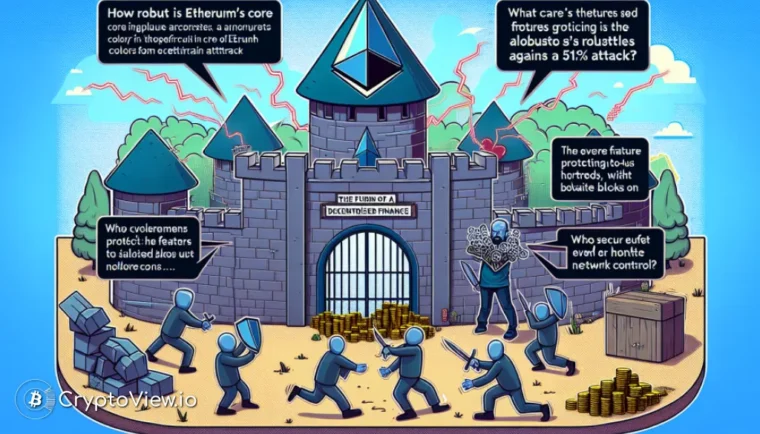
Despite the theoretical threat of a 51% attack, Ethereum’s core architecture, as highlighted by co-founder Vitalik Buterin, fundamentally safeguards user assets by preventing invalid blocks from becoming valid. This inherent design principle is crucial for Ethereum 51% attack security, ensuring funds remain secure even under hostile network control and making it a cornerstone for decentralized finance.
Price of Ethereum (ETH)
The Unyielding Core: Preventing Invalid Blocks from Becoming Valid
One of the most critical properties of a blockchain, particularly Ethereum, is its resistance to malicious manipulation, even in the face of a significant network takeover. Vitalik Buterin emphasized that even if a majority of validators (over 51%) were to collude or be compromised by a software bug, they *cannot* transform an invalid transaction or block into a valid one. This foundational rule means that user assets are inherently protected; validators cannot simply steal funds by creating fraudulent blocks, as the network’s protocol rules would reject them.
This security model is a cornerstone of Ethereum’s integrity. It ensures that the blockchain’s state remains consistent and trustworthy, regardless of the intentions of a majority of its validators. While a 51% attack could potentially disrupt transaction finality or censor specific transactions, it cannot fundamentally alter the historical record or create new, illegitimate assets. This robust design is a key differentiator, providing a strong guarantee for asset safety on the network.
Layer 2 Solutions: Enhancing Ethereum 51% Attack Security and Scalability
Ethereum’s Layer 2 (L2) ecosystem, including prominent solutions like Arbitrum, Optimism, Base, and Worldchain, further leverages the underlying Layer 1’s security guarantees. These L2s currently command over $35 billion in locked value, a testament to their growing adoption and trust. Their security models are intrinsically linked to Ethereum’s mainnet, meaning that the same principles preventing invalid blocks on Layer 1 extend to the assets and transactions processed on L2s.
Even if an L2 experiences a localized attack or bug, the ultimate settlement and dispute resolution mechanisms reside on Ethereum’s Layer 1. This architecture ensures that user funds on L2s remain secure, as they can eventually be withdrawn to the mainnet, validated by Ethereum’s robust security rules. This nested security model allows L2s to offer enhanced scalability and lower transaction costs while inheriting the formidable Ethereum 51% attack security of the base layer.
Solana’s Interoperability Vision: A Bridge to Ethereum’s L2 Ecosystem?
The conversation around blockchain security and interoperability recently saw an interesting twist with Solana co-founder Anatoly Yakovenko’s proposal for a specialized bridge connecting Solana to Ethereum as if Solana were an L2. While both are distinct Layer 1 blockchains with their own security mechanisms, Yakovenko’s concept explored a scenario where Solana could potentially settle on Ethereum, much like traditional L2s do. He posited that in such a setup, a 51% attack on Solana would merely delay the chain rather than compromise bridged assets.
This discussion sparked considerable crypto market buzz, highlighting the ongoing quest for seamless cross-chain interactions without sacrificing security. While some argue that Ethereum’s L2s already offer superior user experience and lower costs, the idea of deeper integration between major L1s like Ethereum and Solana underscores the industry’s drive towards a more interconnected blockchain landscape. On-chain metrics have shown fluctuating market dynamics between the two, with Solana’s performance against Ethereum showing a period of outperformance in August, followed by a lag since late September.
Trend of Ethereum (ETH)
Automating Defense: Ethereum’s Evolving Countermeasures
Looking ahead, the Ethereum community is continually exploring ways to bolster its resilience. In 2024, Buterin had proposed automating responses to 51% attacks, aiming to create a system where validator nodes could autonomously detect and counteract censorship or other malicious activities on the main chain. This forward-thinking approach underscores a commitment to proactive security measures, moving beyond passive resistance to active defense.
The vision is for validator software to automatically identify and react to detected censorship of transactions or validators, or even if the node itself is being censored. Such an automated system would significantly enhance the network’s ability to maintain integrity and availability even under duress, further strengthening the overall security posture. This continuous innovation is part of why many developers and users continue to have *diamond hands* when it comes to the network’s long-term viability.
For those tracking these intricate market movements and security developments, platforms like cryptoview.io offer comprehensive tools to monitor network health and asset performance, providing valuable insights into the ever-evolving crypto landscape. Find opportunities with CryptoView.io


