
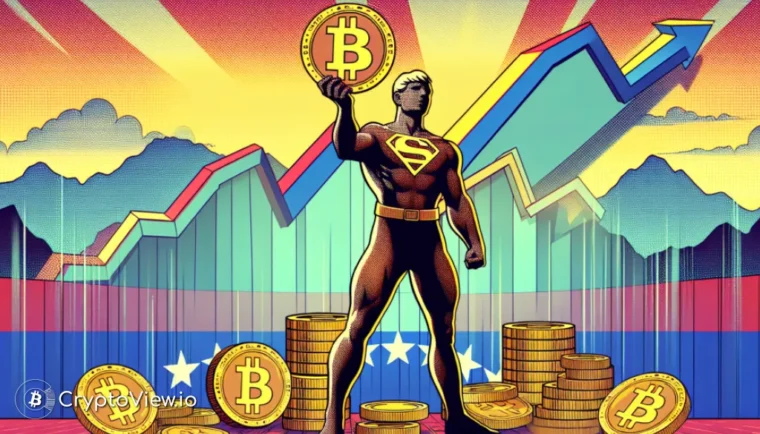
Venezuelan opposition leader Maria Corina Machado’s Nobel Peace Prize win brought global attention to her advocacy for democratic rights and underscored Bitcoin’s role in Venezuela, where citizens increasingly leverage digital assets to circumvent financial repression and hyperinflation. Her public embrace of Bitcoin highlighted its practical applications, from facilitating uncensorable donations to serving as a crucial hedge against the nation’s severe economic challenges.
Price of Bitcoin (BTC)
Bitcoin: A Lifeline for Political Dissent and Donations
Maria Corina Machado, a prominent figure in Venezuela’s opposition, garnered the Nobel Peace Prize for her relentless efforts in championing democratic rights. Beyond her political activism, Machado is a vocal Bitcoiner, having openly advocated for cryptocurrency as a vital tool for change. Facing significant government crackdowns on traditional financial channels, her movement actively sought and accepted donations in Bitcoin. This strategic move proved critical, as she noted that, unlike conventional bank wires often blocked by the regime, Bitcoin donations are inherently censorship-resistant and cannot be seized.
Machado’s vision extended beyond immediate fundraising. She had previously articulated long-term aspirations for Bitcoin, proposing its inclusion as part of a national reserve in the event of a peaceful transition of power. This forward-thinking perspective underscored the potential of decentralized digital assets to underpin a more transparent and resilient financial system, a sentiment resonating deeply within a populace grappling with economic instability.
Understanding Bitcoin’s Role in Venezuela‘s Economic Landscape
For years, Venezuelans have endured a relentless cycle of financial repression, hyperinflation, and a severely devalued national currency. In response, thousands have turned to Bitcoin and other cryptocurrencies as a practical lifeline. On-chain metrics and local market buzz consistently show a significant uptick in crypto adoption, as citizens seek to preserve their wealth and conduct essential transactions outside the crumbling traditional financial infrastructure. Bitcoin, in particular, has emerged as a preferred asset for hedging against inflation, bypassing government-imposed exchange rates, and facilitating low-cost cross-border remittances – a crucial feature for a country with a vast diaspora.
Beyond Bitcoin, stablecoins also command a substantial share of daily transactions. Their peg to more stable fiat currencies, typically the US dollar, offers a degree of predictability and reduces volatility, making them ideal for everyday commerce in an environment where the local bolívar loses value rapidly. As Forbes contributor Javier Bastardo shared in an X post, *“Bitcoin allows me to help my mom with all she needs in a disaster like Venezuela. I can support her because of Satoshi Nakamoto. You can’t understand how important this tech is to me and my family.”* This personal anecdote powerfully illustrates the profound impact of decentralized finance on individual lives, offering a glimmer of hope and practical solutions where traditional systems have failed.
Trend of Bitcoin (BTC)
Government’s Shifting Stance and Future Outlook
Interestingly, the Venezuelan government itself has shown a pragmatic, albeit contradictory, approach to cryptocurrencies. While historically attempting to control and restrict crypto usage, there have been instances where the regime has explored leveraging digital assets for its own strategic interests. Notably, there were discussions and plans to utilize cryptocurrencies, especially stablecoins, for oil sales. This move was primarily aimed at sidestepping international sanctions, particularly those imposed by the United States, highlighting the dual-use nature of digital assets – a tool for both citizen empowerment and state maneuvering.
The evolving dynamic between the government and its citizens regarding cryptocurrency adoption paints a complex picture. On one hand, the state seeks to harness crypto’s benefits for its own economic survival. On the other, the population continues to embrace it as a means of personal financial freedom and resilience. This ongoing interplay underscores the transformative potential of decentralized technologies in challenging geopolitical and economic environments. The future outlook suggests that digital assets will remain an indispensable component of Venezuela’s financial fabric, continuously adapting to the nation’s unique circumstances.
For those tracking the dynamic shifts in emerging markets like Venezuela, platforms offering real-time data and analytics can be invaluable. Tools like cryptoview.io provide comprehensive insights into global crypto trends and local adoption patterns, helping users navigate complex market conditions. Explore Crypto Trends with CryptoView.io


