
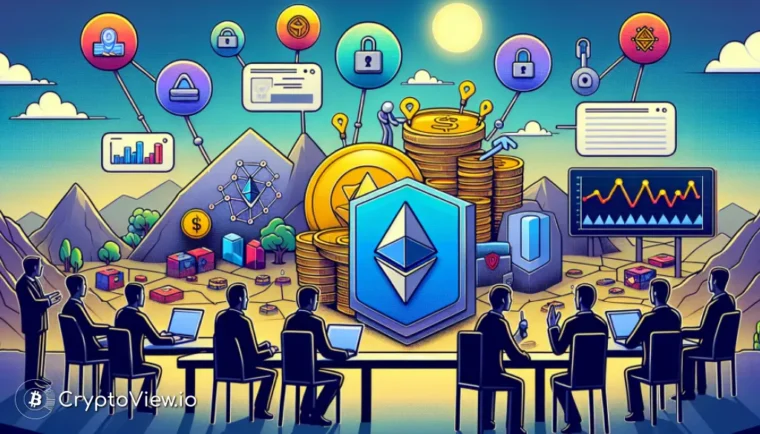
With over $35 billion in total value locked across major platforms like Arbitrum, Base, Optimism, and Worldchain, the debate intensifies over whether Ethereum’s Layer-2 networks truly mitigate Ethereum L2 security risks or introduce new vulnerabilities. While Vitalik Buterin asserts L2s inherit Ethereum’s base-layer finality, Solana’s Anatoly Yakovenko contends their design remains "fundamentally broken," sparking crucial discussions among developers and investors alike.
Price of Ethereum (ETH)
Buterin’s Confidence in L2 Architecture
Ethereum co-founder Vitalik Buterin has consistently expressed strong confidence in the security model underpinning Ethereum’s Layer-2 networks. His core argument hinges on the principle of inherited security: L2s, by design, are meant to leverage Ethereum’s robust base-layer finality, making them resilient against common threats like 51% attacks. This means that even if an L2’s validator set were compromised, the ultimate security of user funds would still be guaranteed by the underlying Ethereum mainnet.
However, Buterin isn’t without caution. He has pointed out that potential risks emerge when L2 validator sets take on functions or responsibilities that operate outside Ethereum’s direct control. Such deviations could, in theory, undermine the very security guarantees L2s are designed to inherit. This nuanced perspective acknowledges the significant value L2s currently secure, supported by Ethereum’s massive validator network, but also highlights the importance of careful design and implementation.
Unpacking Ethereum L2 Security Risks: Yakovenko’s Critique
In a direct challenge to Buterin’s optimism, Solana co-founder Anatoly Yakovenko has publicly dismissed claims of inherent L2 security as "erroneous." Yakovenko argues that despite years of development, Ethereum’s Layer-2 solutions still grapple with worst-case security scenarios akin to those faced by cross-chain bridges like Wormhole, which have historically been targets for major exploits. He insists that there’s something "fundamental" preventing L2s from achieving full security, a challenge he believes remains unsolved even after half a decade of effort.
Yakovenko’s critique zeroes in on three primary design flaws he perceives in current L2 implementations:
- Complex Codebases: The intricate nature of L2 smart contracts and protocols increases the surface area for potential bugs and vulnerabilities, making them more susceptible to attack.
- Multi-Signature Custody: Many L2s rely on multi-signature schemes for fund management, which, if compromised or controlled by a small group, could allow funds to be moved without proper user authorization.
- Off-Chain Processing and Centralization: The reliance on off-chain computation and data availability can lead to a degree of centralization, potentially giving a handful of operators too much control over network operations and user assets.
Intriguingly, Yakovenko even floated the idea of building a specialized bridge to integrate Ethereum as a Layer-2 for Solana, suggesting this could improve interoperability and address what he views as persistent security shortcomings in Ethereum’s scaling solutions. This bold proposal underscores the depth of his concern regarding current L2 designs.
The Ongoing Technical Debate and Market Sentiment
The clash between these two industry titans has naturally fueled extensive discussion within the crypto community. Many Ethereum supporters counter Yakovenko’s claims, asserting that there’s "nothing fundamental" preventing L2s from fully inheriting Ethereum’s security. They point to ongoing upgrades and the evolution of L2s, particularly Stage 2 networks, which are designed to function like secure vault contracts with comprehensive Layer-1 protection. These proponents argue that Yakovenko’s criticisms may overlook the continuous advancements and rigorous auditing processes within the L2 ecosystem.
However, the underlying concern about Ethereum L2 security risks persists for a segment of the market, particularly given the growing value locked on these networks. The debate highlights the tension between achieving scalability and maintaining uncompromising security, a balance that developers are constantly striving to perfect. As the ecosystem matures, robust security audits and transparent communication about potential vulnerabilities become paramount to maintaining user trust and fostering wider adoption.
Trend of Ethereum (ETH)
Retrospective Market Performance: ETH vs. SOL
Looking back at the past year leading up to October 28, 2025, both Ethereum (ETH) and Solana (SOL) demonstrated similar price trajectories, often rising and falling in relative sync with broader market movements. Over this period, Ethereum recorded a gain of approximately 15.45%, while Solana saw a climb of about 7.39%. Both assets experienced significant rallies mid-year, before a slight cooling off period in September, followed by a steady recovery into late October. At the close of this period, Ethereum maintained a modest lead in year-over-year performance.
For those tracking these dynamic market shifts and assessing potential vulnerabilities, platforms like cryptoview.io offer valuable insights into network health and asset performance, helping users navigate the complexities of the crypto landscape. Find opportunities with CryptoView.io


