
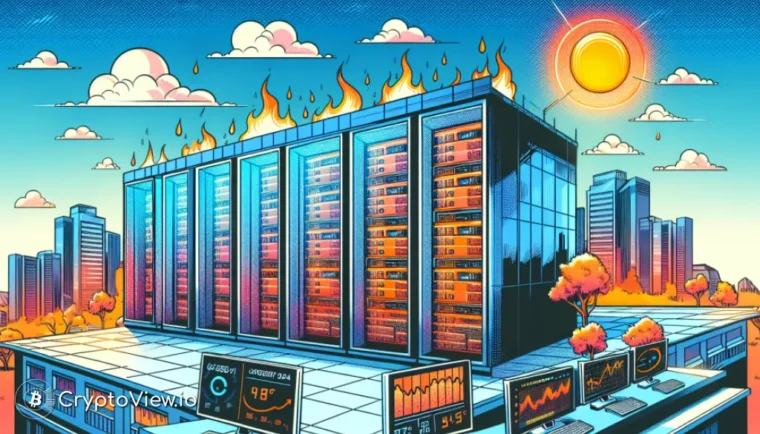
A recent global analysis revealed that approximately 600 data centers, less than 10% of the worldwide total as of October 2025, operate in regions where average annual temperatures consistently exceed 27 degrees Celsius, posing significant challenges for efficient Data Center Cooling Hot Climates. This situation escalates operational costs, strains energy grids, and raises long-term sustainability concerns for the digital infrastructure underpinning everything from cloud services to blockchain networks.
Price of Bitcoin (BTC)
The Global Heat Challenge for Digital Infrastructure
The digital economy’s relentless expansion, fueled by burgeoning demand for cloud computing, generative AI, and the ever-growing Web3 ecosystem, is pushing data center development into diverse geographical locations. A comprehensive report, which mapped nearly 9,000 operational data centers across 21 countries and benchmarked them against the American Society of Heating, Refrigerating and Air-Conditioning Engineers (ASHRAE) optimal range of 18°C to 27°C, highlighted a critical issue. While most of the nearly 7,000 facilities outside this optimal range are in colder climates, a significant number face the opposite extreme.
Countries like Singapore, Thailand, Nigeria, and the United Arab Emirates (UAE) host data centers entirely within zones deemed too hot for conventional, efficient cooling. Similarly, almost all facilities in Saudi Arabia and Malaysia, about half in Indonesia, and roughly 30% in India contend with excessively warm environments. Despite these hurdles, investment continues unabated, driven by national strategies to meet data sovereignty requirements and support the computational demands of emerging technologies.
Energy Strain and Operational Risks in Hot Regions
Operating data centers in high-temperature zones carries substantial implications. The increased need for cooling directly translates to higher electricity consumption, which not only inflates operational expenses but also places immense strain on local electricity grids. This heightened demand exacerbates the risk of power outages, a critical concern for continuous operations, especially for high-availability services like those supporting cryptocurrency exchanges or decentralized applications. For instance, Singapore, despite all 72 of its data centers being in sub-optimal climates, already boasts over 1.4 gigawatts of capacity and plans to add another 300 megawatts. This commitment underscores the strategic importance of these facilities, even as they face an uphill battle against the mercury.
In 2024, data centers reportedly consumed about 415 terawatt-hours of electricity globally, accounting for approximately 1.5% of total global electricity use. This figure was anticipated to more than double by 2030, underscoring the urgent need for innovative solutions for Data Center Cooling Hot Climates. The financial and environmental pressures are mounting, prompting a serious re-evaluation of traditional cooling methodologies.
Innovative Cooling Solutions for a Warming World
The industry is actively exploring advanced alternatives to conventional air cooling to mitigate these heat-related challenges. These cutting-edge technologies aim to significantly reduce energy and water consumption, offering a more sustainable path forward for digital infrastructure. Key innovations include:
- Direct-to-chip liquid cooling: This method brings coolant directly to the heat source, offering superior efficiency compared to air.
- Hydro-cooling: Utilizing water-based systems to dissipate heat, often integrated with existing infrastructure.
- Immersion cooling: Servers are fully submerged in a non-conductive dielectric fluid, providing highly effective and uniform cooling.
- Hybrid systems: Combining different cooling approaches tailored for specific hot and humid environments.
While these technologies promise substantial benefits, their implementation is often more straightforward in new builds than in retrofitting existing facilities. This leaves a significant portion of older data centers in hot regions exposed to long-term resilience risks, necessitating a strategic approach to upgrades and modernization. The market buzz suggests that for many operators, adopting these new cooling methods isn’t just an option, it’s a necessity to ensure long-term viability and contribute to a greener digital future.
Trend of Bitcoin (BTC)
The Future of Sustainable Digital Infrastructure
The imperative for sustainable Data Center Cooling Hot Climates extends beyond operational efficiency; it’s crucial for the environmental footprint of the entire digital landscape, including the energy-intensive processes of blockchain validation and AI model training. As the crypto market continues to evolve, exemplified by Bitcoin’s consolidation near $88K earlier this year, the underlying infrastructure must adapt to environmental realities. The commitment to building resilient, energy-efficient data centers reflects a long-term vision, a true *diamond hands* approach to technological development. Understanding these infrastructure challenges is key for anyone tracking the broader digital asset space. For those looking to gain deeper insights into market trends and the performance of various digital assets, platforms like cryptoview.io offer valuable analytical tools. Find opportunities with CryptoView.io


