
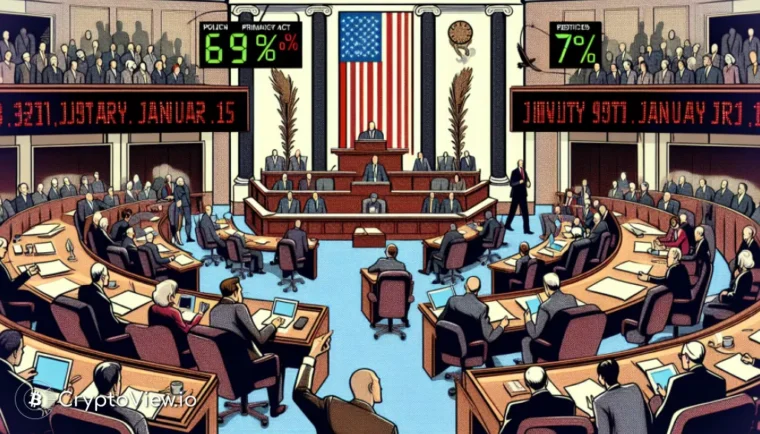
With the expected launch date of January 15th looming, the CLARITY Act faces a critical juncture in the U.S. Senate. Prediction markets on Kalshi recently indicated a 69% probability of the bill becoming law before May, highlighting the intense focus on the upcoming CLARITY Act Senate deadline as lawmakers scramble to finalize the landmark legislation before the Martin Luther King Jr. Day recess.
The Legislative Sprint to the CLARITY Act Senate Deadline
As the digital asset industry steps into 2026, the usual optimistic market outlook has quickly shifted to a high-stakes legislative countdown in Washington. The Senate Banking Committee is currently in a ‘make-or-break’ phase, with a crucial bipartisan meeting having just taken place on January 6th. This wasn’t merely a routine briefing; lawmakers were making a final, concerted push to align the Senate’s version of the market structure bill before time completely runs out. The clock is ticking relentlessly, with less than two weeks remaining until the Martin Luther King Jr. Day recess.
This tight schedule leaves little room for error or prolonged debate. Senators must quickly resolve long-standing disputes surrounding DeFi regulation and, crucially, determine how to effectively divide authority between the Securities and Exchange Commission (SEC) and the Commodity Futures Trading Commission (CFTC). Brendan Pedersen, a finance reporter for Punchbowl News, aptly captured the sentiment, noting, “January is crunch time for the Senate Banking Committee on this effort to retool the shape of the financial system.” The pressure is palpable, as the outcome could define the regulatory landscape for digital assets for years to come.
Navigating the Bipartisan Battlefield
Progress on integrating digital assets into the U.S. financial system has been repeatedly stalled by months of deadlock, particularly in late 2025. This gridlock has significantly eroded the usual spirit of bipartisan cooperation. The primary sticking points remain disagreements among lawmakers concerning DeFi oversight and the extent of the SEC’s regulatory authority over the burgeoning crypto sector. This tension reached a critical peak under the leadership of Committee Chair Tim Scott.
Scott’s January 6th meeting followed a stark warning he issued in December 2025, emphasizing that time to reach a consensus was rapidly diminishing. He has clearly signaled a potential shift in strategy: if the deadlock persists further into 2026, he is prepared to abandon the bipartisan approach. This means he could move to push the bill toward markup without securing Democratic support, a move that would undoubtedly create further friction but underscores the urgency to pass the legislation. The industry watches closely, hoping for a breakthrough that can end the prolonged era of “regulation by enforcement” that has burdened U.S. crypto firms.
Market Reaction and Institutional On-Ramps
The crypto market, led by Bitcoin [BTC] and its significant share of the $3.21 trillion digital asset economy, has been keenly awaiting regulatory clarity. Throughout Q4 of 2025, a muted risk appetite was observed, with the CoinMarketCap Altcoin Season Index suppressed at a dismal 22/100. During this period, capital inflows predominantly moved into the perceived safety of Bitcoin and Ethereum [ETH] ETFs, reflecting investor caution amidst regulatory uncertainty. Analysts at Bull Theory had noted that with the ALT/BTC pair at multi-year oversold levels, the tide appeared ready to turn, suggesting a potential rotation back into altcoins.
While analysts had previously set their sights on Bitcoin steadily grinding towards the historic $95,000 mark, the broader market’s momentum continues to build, contingent on regulatory progress. The passage of the CLARITY Act would provide institutional investors with the crucial legal green light they need. This would enable them to confidently diversify their portfolios beyond just the major assets like BTC and ETH, potentially unlocking a new wave of liquidity and innovation across the altcoin ecosystem. Many in the space believe this could finally end the “regulatory winter” that has seen many institutional players remain on the sidelines, waiting for clearer guidelines.
The Shifting Odds: What Prediction Platforms Reveal
On January 1, 2026, prediction platform Kalshi reported a significant surge in confidence regarding the CLARITY Act’s prospects. As of early January, traders were pricing in a substantial 69% chance that the CLARITY Act will be signed into law before May. Similarly, on Polymarket, the odds saw a notable increase, climbing from a bleak 15% to a more optimistic 35% following year-end legislative updates. These shifts in prediction markets reflect a renewed, albeit cautious, momentum that the bill might indeed survive the legislative gauntlet.
If the CLARITY Act successfully navigates the next two weeks in the Senate and meets its CLARITY Act Senate deadline, it could finally signal the end of the long-standing regulatory uncertainty. This would pave the way for a new era of institutional growth and broader adoption within the digital asset space. For those tracking these legislative shifts and their potential market impact, platforms like cryptoview.io offer valuable insights into digital asset trends and portfolio management. Find opportunities with CryptoView.io


