
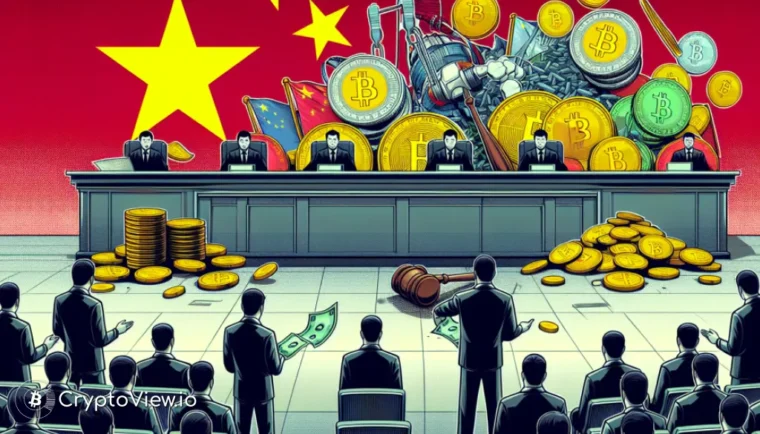
A Beijing court recently handed down significant sentences to five individuals involved in China illegal USDT conversions, totaling approximately $166 million (1.2 billion RMB), underscoring the nation’s stringent stance against unregulated digital asset transactions and its commitment to financial stability. This high-profile case highlights China’s ongoing efforts to control its financial ecosystem.
Beijing’s Unwavering Stance on Digital Currencies
Chinese authorities continue to maintain a firm grip on the digital asset market, with this recent court ruling serving as a stark reminder of their resolve. The judgment, which saw five defendants jailed and heavily fined, sent ripples through the global crypto community. While many nations explore the integration of digital assets, China has consistently prioritized national financial stability and control over cross-border capital flows, viewing unregulated crypto transactions as a significant threat to these objectives. This consistent regulatory pressure aims to limit the influence of decentralized cryptocurrencies, particularly stablecoins like USDT, which can bypass traditional banking channels.
The government’s crackdown isn’t new; it’s a sustained campaign against activities deemed to be *disguised foreign exchange trading*. This legal interpretation allows Chinese courts to apply stringent anti-money laundering laws and foreign exchange administration regulations to crypto-related activities, even if they occur solely within digital wallets before conversion to fiat currency. The message is clear: any transaction facilitating capital outflow outside state-sanctioned channels will face severe repercussions.
The Anatomy of Illegal Cross-Border Transfers
The recent Beijing case detailed a sophisticated operation involving substantial sums. The defendants reportedly used renminbi (RMB) to acquire USDT through various local digital asset channels. These stablecoins were then transferred to wallets, from which they were subsequently exchanged for foreign currencies and utilized for international payments. This entire process, which circumvented official banking routes, was the core of the prosecution’s argument.
Court documents revealed that the defendants facilitated approximately 1.2 billion RMB, equivalent to about $166 million, across multiple transactions. The scale of this operation made it one of the largest crypto-forex cases seen in China this year. The authorities’ focus was not just on the volume but on the method, emphasizing that such transactions occur outside regulated financial frameworks, thus violating the nation’s strict financial oversight.
Penalties and Market Repercussions from China illegal USDT conversions
The sentences handed down were notably severe, reflecting the court’s hardline approach. The lead defendant received four years and six months in prison, alongside a fine of 200,000 RMB (approximately $28,000). Two accomplices were sentenced to three years and nine months, with fines of 150,000 RMB ($21,000), while the remaining defendants faced two years and eleven months in prison, plus 100,000 RMB ($14,000) fines. These penalties underscore the significant legal risks associated with engaging in such activities within China.
While some in the crypto community advocate for regulations to curb illicit activities, many analysts and social media commentators viewed these particular sentences as exceptionally harsh. The sentiment is that such crackdowns, especially on stablecoin usage, are primarily aimed at reinforcing fiat controls and limiting the broader influence of decentralized digital assets. This approach, while maintaining financial control, can sometimes stifle innovation and impact market sentiment, leading to a more cautious approach from domestic participants.
Hong Kong’s Contrasting Crypto Vision
In stark contrast to mainland China’s restrictive stance, Hong Kong continues to position itself as a hub for Web3 innovation. The special administrative region has actively courted new investors and businesses, particularly those interested in stablecoins and other digital assets. This divergence creates a unique dynamic within the broader Chinese economic sphere, with Hong Kong aiming to capitalize on the very innovations that Beijing seeks to control.
Hong Kong’s commitment to fostering a regulated yet open environment for digital assets attracts a different kind of capital flow and talent. This dual approach within the greater China region highlights the complex and evolving landscape of cryptocurrency regulation. For those navigating these intricate market dynamics, platforms like cryptoview.io can offer invaluable insights into global regulatory trends and market movements, helping users make informed decisions. Find opportunities with CryptoView.io


