
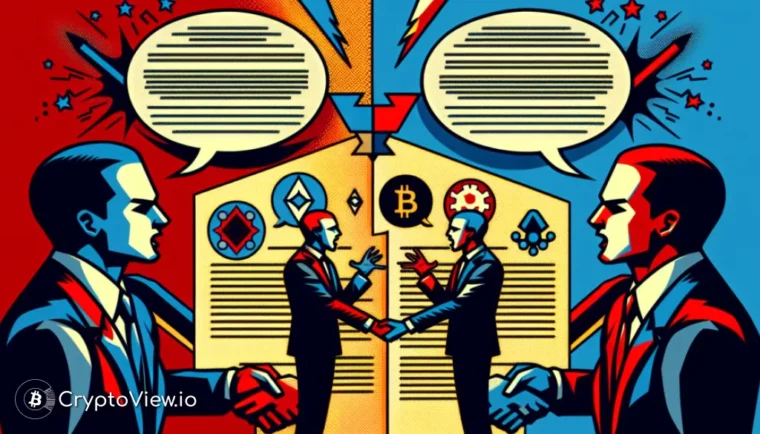
In a notable industry clash, Cardano co-founder Charles Hoskinson vehemently opposed the Digital Asset Market Clarity Act, or the Charles Hoskinson CLARITY Act, labeling it a "dangerous compromise" rather than a genuine step towards regulatory certainty. Hoskinson’s strong stance came after Ripple CEO Brad Garlinghouse voiced support for the bill, sparking a significant debate within the crypto community regarding the future of digital asset regulation in the United States.
Hoskinson’s Stance: A "Dangerous Compromise" for Crypto
During a recent livestream, Charles Hoskinson articulated his profound concerns regarding the proposed Digital Asset Market Clarity Act. He argued that the legislation, while ostensibly designed to establish a comprehensive regulatory framework for cryptocurrencies and exchanges, would paradoxically grant an excessive amount of power to U.S. regulators, particularly the Securities and Exchange Commission (SEC). Hoskinson contended that the bill fundamentally undermines the decentralized ethos of crypto by defaulting all new projects to be classified as securities. This approach, he suggested, would compel innovators to "beg and plead" for exemptions, rather than fostering an environment of free operation and innovation.
Hoskinson drew a stark comparison, asking rhetorically if this framework was any better than the regulatory landscape under current SEC leadership. His core criticism centered on the idea that signing off on a flawed bill now would create long-term, irreversible problems, much like the enduring impact of the 1933 Securities Exchange Act. *"You pass it, you own it forever,"* he observed, dismissing the notion that an imperfect bill is better than no bill at all, especially when it hands significant control to the very entities that have historically pursued enforcement actions against crypto projects.
The Ripple CEO’s Perspective and the Charles Hoskinson CLARITY Act Debate
Contrasting sharply with Hoskinson’s revolutionary stance, Ripple CEO Brad Garlinghouse publicly lauded the CLARITY Act on social media, hailing it as a "massive step forward." Garlinghouse’s endorsement underscored his belief that "clarity beats chaos," a sentiment rooted in Ripple’s own prolonged legal battles for regulatory definition. He argued that the bill offered workable frameworks for crypto while simultaneously aiming to protect consumers, suggesting its success would be a win for the entire crypto ecosystem. This divergence in opinion highlighted a fundamental schism within the industry: whether to accept incremental, potentially flawed, progress or to hold out for a legislative framework that fully embodies crypto’s foundational principles.
Coinbase’s Pivotal Withdrawal and Legislative Stalls
The controversy surrounding the CLARITY Act intensified significantly when Coinbase, a major U.S. crypto exchange heavily involved in the bill’s negotiations and lobbying efforts, abruptly withdrew its support. This move, which occurred just hours before a scheduled U.S. Senate Banking Committee hearing, sent ripples through the legislative process. Coinbase CEO Brian Armstrong publicly stated that the draft bill, in its then-current form, posed more risks than benefits, emphasizing that *"we’d rather have no bill than a bad bill."*
Coinbase’s concerns were multifaceted, touching upon several critical areas:
- A potential ban on tokenized equities.
- Broad restrictions impacting decentralized finance (DeFi) protocols.
- Provisions related to stablecoin yield.
- Increased government access to financial records, raising significant privacy concerns for users.
Following Coinbase’s high-profile withdrawal, the U.S. Senate Banking Committee indeed postponed its markup of the bill, subsequently relaunching discussions with industry representatives. This legislative pause underscored the deep divisions and the complexity of crafting effective, balanced crypto regulation that satisfies both industry demands for innovation and governmental calls for consumer protection and market stability. The ongoing dialogue around the Charles Hoskinson CLARITY Act continues to shape the future regulatory landscape for digital assets.
Navigating the Path Forward for Crypto Regulation
The intense debate surrounding the CLARITY Act, involving prominent figures like Charles Hoskinson and Brad Garlinghouse, alongside key industry players such as Coinbase, illustrates the intricate challenges of establishing a robust regulatory framework for digital assets. The industry remains divided between those advocating for immediate, even if imperfect, clarity and those who fear that compromised legislation could stifle innovation and betray crypto’s core principles of decentralization and freedom. As lawmakers continue their engagement with crypto stakeholders, the focus remains on finding common ground that can provide necessary oversight without stifling the transformative potential of blockchain technology. Keeping track of these legislative developments is crucial for anyone involved in the digital asset space. For those looking to monitor market movements and regulatory shifts, tools like cryptoview.io can offer valuable insights into the evolving landscape.


