
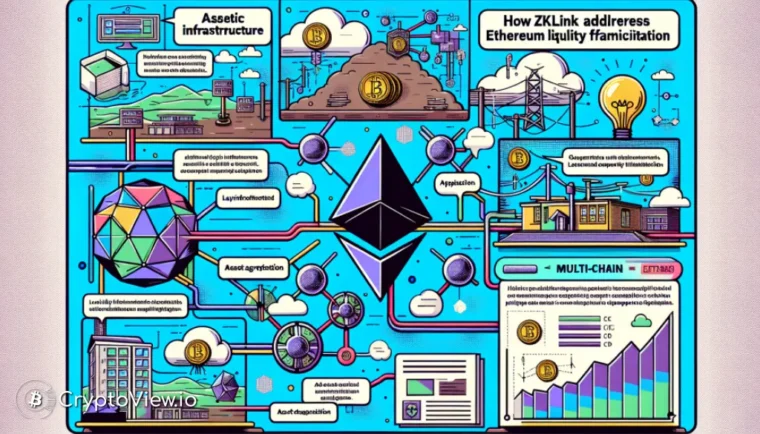
Is the zkLink Nova platform the solution to Ethereum’s liquidity and composability issues? This is a question many in the crypto community are pondering. The rapid expansion of Ethereum’s Layer-2 (L2) rollups has led to significant liquidity fragmentation and weakened composability within its ecosystem. However, the emergence of Layer-3 (L3) solutions, specifically zkLink Nova, aims to unify assets, decentralized applications (dApps), and users scattered across various L2s into a cohesive network.
Understanding zkLink Nova’s Approach
zkLink Nova, as a pioneering L3 infrastructure provider, leverages zero-knowledge proofs to aggregate disparate elements of the Ethereum ecosystem. This approach addresses the core issues of liquidity and asset fragmentation by offering a general-purpose L3 network. It brings together assets and dApps from multiple L2s, enabling them to interact seamlessly and efficiently. Such integration not only enhances the user and developer experience on Ethereum but also maintains the ecosystem’s value by preventing the migration of dApps to alternative Layer-1 (L1) platforms in pursuit of better performance and economic opportunities.
The Technology Behind zkLink Nova
The architecture of zkLink Nova is built on four foundational layers: sequencing, execution, settlement, and data availability. Each layer plays a critical role in ensuring the platform’s efficiency and security. For instance, the sequencing layer organizes transactions for processing, while the execution layer, powered by ZK Stack’s zkEVM, provides a secure, EVM-compatible environment for transaction execution. The settlement framework, zkLink Nexus, facilitates efficient cross-L2 and Ethereum settlements. Lastly, the data availability layer is responsible for storing transaction and state transition data, with plans to integrate external solutions for enhanced security.
By consolidating assets and liquidity from various L2s into a single platform, zkLink Nova offers developers a unified environment for deploying their dApps. This not only simplifies the user experience but also reduces gas fees and improves capital efficiency. Moreover, the platform’s use of zk-SNARKs ensures the secure consolidation of assets, merging tokens of identical value into a single token and enhancing overall interoperability within the Ethereum ecosystem.
Benefits of zkLink Nova’s L3 Solution
- Aggregation of Liquidity: zkLink Nova effectively consolidates liquidity within the Ethereum ecosystem, allowing for native integration and interaction of assets across various L2 solutions.
- Security: The platform maintains Ethereum’s high level of security for all transactions, which are finalized on the Ethereum mainnet.
- Reduced Gas Fees: As an additional layer of scaling beyond L2s, zkLink Nova offers significantly lower gas fees for users.
- Multi-Layer Yield Structure: The platform supports all native yield assets in a single platform, enhancing their liquidity and composability and enabling additional yield generation.
With over $300 million bridged to zkLink Nova, it stands as the largest L3 network in terms of total value bridged, underscoring its potential to address the challenges of liquidity fragmentation within the Ethereum ecosystem. As the debate over L3 solutions continues, platforms like zkLink Nova are poised to play a crucial role in enhancing interoperability, efficiency, and user experience across the blockchain space.
For those looking to stay ahead in the rapidly evolving world of cryptocurrencies, tools like cryptoview.io offer invaluable insights and opportunities.
Find opportunities with CryptoView.io

