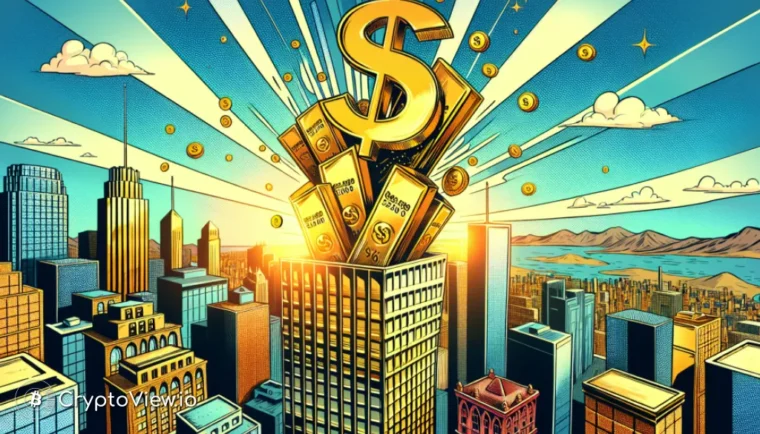
As of February 2, 2026, the global financial landscape continues to grapple with inflationary pressures, reigniting debates about the stability of fiat currencies. While gold previously traded near $5,000 an ounce, the long-standing forecast of Gold $20K Ron Paul suggests a dramatic revaluation could still be on the horizon, driven by the looming “climactic end” of the current monetary system.
The Looming Fiat Currency Reckoning
Former Texas congressman Ron Paul, a consistent voice for libertarian principles, has long warned that the global fiat monetary system is on a collision course with reality. He posits that decades of unchecked government spending, relentless currency debasement, and an ever-expanding national debt, now exceeding $38 trillion, have fundamentally eroded the dollar’s credibility both domestically and on the international stage. Paul argues this isn’t merely an accounting issue but a systemic failure where governments fund obligations not through genuine savings, but by the insidious mechanism of money creation.
This process, according to Paul, quietly siphons purchasing power from the average citizen, enriching those closest to the newly printed money. He has consistently articulated that this “stealing of purchasing power” through an increased money supply is an unsustainable path. The discussion around Gold $20K Ron Paul gains particular traction when considering these deep-seated concerns about monetary integrity and the potential for a severe economic realignment.
Inflation’s Hidden Tax and Its Societal Impact
Paul characterizes inflation as a “hidden tax” that disproportionately burdens the middle and lower classes. While politically connected institutions and wealthy individuals often benefit first from new money entering the system, ordinary citizens see their wages and savings lag behind escalating prices. He emphatically states that this inflation tax can be more damaging than income taxes, hitting the poor the hardest by eroding their limited purchasing power and widening income inequality.
This erosion of confidence in fiat currencies directly correlates with the historical ascent of gold. When Paul observed gold’s price nearing $5,000 per ounce, he noted that sharp daily movements, sometimes exceeding $100, signaled a profound shift in market sentiment. These dramatic price swings, he suggested, reflect a growing collective realization that government-issued money is losing its store-of-value function. The veteran politician, despite decades of issuing similar warnings, admitted even he was surprised by the accelerating pace of these market dynamics.
The Audacious Forecast: Gold $20K Ron Paul Revisited
When pressed on whether the fiat system is truly nearing its demise, Paul’s response was unequivocal: “Yes, it is dying.” While acknowledging the uncertainty surrounding the precise timing and trajectory of this breakdown, he echoed sentiments from other prominent financial figures, like Ray Dalio, who have also pointed to the inherent instability of the global monetary order due to unsustainable debt trajectories. Paul has previously made a bold prediction that gold could one day reach $20,000 per ounce. He frames this not as a bullish market call for gold itself, but rather as a stark reflection of the dollar’s potential collapse.
Reflecting on gold’s historical journey from $20 to $200, then to $2,000, Paul famously quipped, “There’s going to be another zero in our lifetime.” However, he also injects a dose of realism, cautioning that the system might fail even before such a price target is reached. In a true monetary breakdown, he posits, the very act of measuring value in a debased dollar becomes meaningless. This perspective suggests that while a gold price outlook of $20,000 might seem like a moonshot, it underscores the severe consequences of continued monetary mismanagement.
Beyond Markets: Geopolitical Shifts and Liberty Concerns
The implications of economic instability extend far beyond financial markets, according to Paul. He warns that such periods frequently lead to political and social upheaval, with civil liberties often becoming the first casualty as governments attempt to control the chaos. He has highlighted increasing constraints on free speech and open debate, arguing that economic stress makes authoritarian responses more probable. Geopolitical alliances, such as NATO, could also become ineffective if the U.S. dollar’s dominance wanes, as financial exhaustion, rather than diplomacy, often dictates the end of conflicts.
Despite this grim outlook, Paul maintains a degree of cautious optimism regarding public awareness. He observes that younger generations appear increasingly receptive to alternative economic theories, including Austrian economics, and are more skeptical of centralized monetary control. The internet, while a conduit for misinformation, has also played a crucial role in disseminating these ideas, fostering a new cohort of critical thinkers. As policymakers continue to delay confronting fiscal realities, the risk of disorder grows, making a smooth transition to a healthier system increasingly challenging. For those tracking these complex market dynamics and seeking clarity, platforms like cryptoview.io offer valuable insights into how digital assets and traditional safe-havens are reacting to global economic shifts. Find opportunities with CryptoView.io