
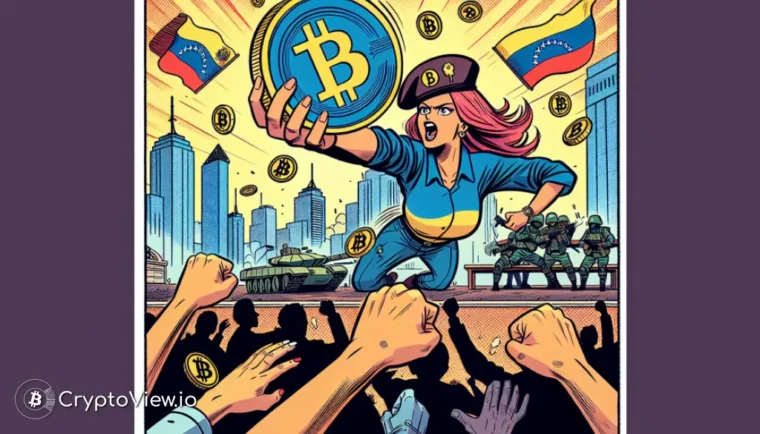
Following her 2025 Nobel Peace Prize win, María Corina Machado publicly hailed Bitcoin as “resistance money,” a critical lifeline for Venezuelans battling hyperinflation and financial repression. This endorsement underscored how the decentralized digital asset functioned as a crucial tool for survival, demonstrating Bitcoin’s role as Bitcoin resistance money Venezuela amidst economic turmoil.
Price of Bitcoin (BTC)
A Nobel Laureate’s Vision for Digital Freedom
María Corina Machado, the recipient of the 2025 Nobel Peace Prize, made headlines not only for her esteemed award but also for her vocal support of Bitcoin. She described the cryptocurrency as a “vital means of resistance” that offered Venezuelans a humanitarian lifeline during periods of extreme hyperinflation and severe financial repression. Her statements highlighted how digital assets enabled citizens to access and preserve value, circumventing state-imposed financial controls and rampant corruption.
This recognition marked a pivotal moment, as it was the first time a Nobel Peace Prize winner had so prominently linked their advocacy to a high-profile endorsement of Bitcoin. Machado’s powerful narrative solidified the perception of Bitcoin resistance money Venezuela, a concept that resonated deeply with citizens seeking financial autonomy and a hedge against the bolívar’s dramatic collapse. Her vision extends beyond mere survival, envisioning Bitcoin as an integral component in the eventual reconstruction of national financial stability post-dictatorship.
Bitcoin’s Lifeline in Hyperinflationary Venezuela
For nearly a decade, Venezuelans have grappled with an economy in freefall, characterized by the bolívar’s near-total collapse and official inflation peaking during prolonged hyperinflationary episodes. In this dire landscape, citizens instinctively turned to alternative financial instruments. Informal dollarization became widespread, but cryptocurrencies, particularly Bitcoin and stablecoins, offered a more robust and accessible workaround.
These digital assets proved indispensable for various practical applications. Venezuelans leveraged them for crucial remittances from family abroad, allowing them to receive funds without navigating restrictive currency controls or falling victim to corrupt intermediaries. Furthermore, Bitcoin served as a reliable store of value, enabling individuals to protect their savings from the bolívar’s relentless depreciation. Cross-border payments, otherwise fraught with obstacles due to U.S. sanctions and a crippled banking system, also became feasible through crypto, providing a much-needed financial conduit when local currency purchasing power had evaporated.
Evolving from Emergency Tool to Strategic Asset
In a September 2024 interview, Machado elaborated on Bitcoin’s transformative journey within Venezuela. She explained that what began as an emergency tool, a desperate measure for survival, had evolved into a strategic instrument for both individual resistance and potential national recovery. Her insights painted a clear picture of how ordinary citizens, often with *diamond hands*, clung to Bitcoin as a last resort against economic tyranny.
Machado emphasized that the financial repression experienced by Venezuelans was rooted in systemic state looting and unchecked money printing, which systematically eroded public trust and economic stability. In this environment, citizens were left with no viable traditional alternatives, pushing them towards decentralized solutions. Bitcoin, in her view, offered a lifeline that not only mitigated the immediate effects of hyperinflation but also provided a glimmer of hope for future financial sovereignty.
This perspective underscores Bitcoin’s potential beyond mere speculation, positioning it as a fundamental element in humanitarian aid and a tool for empowering populations under authoritarian regimes. Its ability to offer a censorship-resistant, permissionless financial network proved critical when traditional systems failed or were weaponized against the populace.
Trend of Bitcoin (BTC)
Broader Policy Implications and the Human Element
María Corina Machado’s Nobel Peace Prize and her explicit advocacy for Bitcoin carry significant symbolic weight, shining a spotlight on the political and humanitarian dimensions of cryptocurrency use in crisis-stricken nations. This high-profile endorsement is likely to prompt renewed debate among policymakers, international organizations, and civil society groups regarding the potential role of digital assets in economic recovery, financial inclusion, and human rights-oriented financial policies.
Experts in the field, such as Jeff Park and Bradley Rettler of the University of Wyoming Bitcoin Research Institute, have publicly lauded Machado’s recognition of crypto’s profound social utility. They affirmed that her comments validate the growing understanding of Bitcoin as more than just an investment vehicle; it is a tool for freedom and resilience. This powerful narrative has cemented the understanding of Bitcoin resistance money Venezuela, showcasing its profound humanitarian and political dimensions.
As the global financial landscape continues to evolve, the Venezuelan experience, highlighted by Machado’s advocacy, offers a compelling case study for the transformative power of decentralized finance. For those looking to understand and track these complex market dynamics, platforms like cryptoview.io offer valuable insights and analytics. Find opportunities with CryptoView.io


