
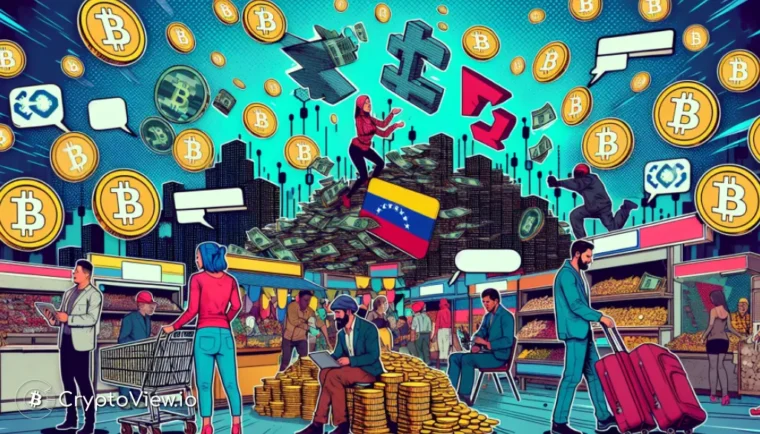
Facing an staggering annual inflation rate that *reached 229% by May 2025*, Venezuela’s economy has increasingly turned to stablecoins, with everyday transactions often settled using *what locals call* Binance dollars Venezuela. This digital shift provides a critical hedge against the volatile bolívar, establishing a de facto dollarization through blockchain technology rather than physical cash. Merchants and citizens alike have embraced these digital assets to maintain purchasing power and streamline commerce.
The Digital Dollar’s Ascent in a Hyperinflationary Environment
Venezuela’s economic landscape has been profoundly reshaped by persistent hyperinflation, which *accelerated significantly by May 2025*, pushing the annual rate well beyond 200%. This volatility rendered pricing in bolívars virtually unworkable, necessitating constant updates to menus and invoices. Concurrently, the bolívar’s depreciation widened the chasm between official and street exchange rates, with the currency losing approximately 30% in the months leading up to July 2025 and roughly 69% year-over-year from July 2024 to July 2025. Merchants, desperate for a stable unit of account, found solace in digital alternatives.
Adding to the pressure was the acute scarcity of physical US dollars, largely a consequence of international sanctions and restricted oil revenues. Digital dollars, predominantly USDT, emerged as a more accessible, storable, and transferable medium for payments, especially for small, frequent transactions. Venezuela has consequently solidified its position as a global leader in grassroots crypto adoption. On-chain activity in 2024 reportedly doubled year-over-year, with stablecoins accounting for approximately 47% of transactions under $10,000, underscoring their pivotal role in anchoring pricing and settlement for households and SMEs.
Understanding Binance dollars Venezuela: More Than Just USDT
In Venezuela, the term “dólares Binance” colloquially refers to USDT (Tether) that is priced and settled via peer-to-peer (P2P) markets, with Binance P2P being the most prominent platform. For countless small businesses, freelancers, and even building administrators, this P2P quote serves a dual purpose: it acts as the day’s benchmark reference price and provides the underlying payment infrastructure. While other applications and over-the-counter (OTC) desks exist, the deep liquidity offered by USDT on these P2P platforms maintains its dominance as the operational standard.
Transactions are overwhelmingly conducted on the Tron (TRC-20) network. The reasons are clear: minimal transaction fees, widespread wallet adoption, and the sheer ease of sourcing and circulating digital dollars compared to the scarce and cumbersome physical USD. This digital flexibility has allowed a robust shadow economy to flourish, providing a lifeline for everyday commerce in a challenging economic climate. The government, while not formally legalizing dollarization, has shown an implicit tolerance for dollar-backed crypto on private exchanges, a pragmatic approach to keep markets functioning.
The Mechanics of Crypto Payments in Everyday Life
The process of making a USDT payment in Venezuela has become remarkably streamlined. At the point of sale, prices are typically displayed in USD. The cashier or vendor then refreshes the live P2P quote, often from Binance P2P, on their phone to determine the bolívar equivalent for settlement in USDT. The customer then scans a QR code linked to the merchant’s Tron (TRC-20) address. Confirmation usually arrives in seconds, with network fees being negligible, though a small TRX balance is required to cover these costs. Merchants then have flexibility: they can *HODL* USDT as working capital, convert a portion to bolívars for operational expenses like salaries and utilities via OTC/P2P desks, or forward USDT to suppliers. This workflow (USD listing, P2P conversion, TRC-20 transfer) now underpins daily payments across the nation.
This system caters to a broad spectrum of users. Households utilize USDT for groceries, condominium fees, rent, and peer-to-peer reimbursements, effectively sidestepping the relentless price shocks of the Venezuelan bolívar (VES). Small and medium-sized businesses (SMEs) manage import restocking, maintain clear management accounts in USD, and selectively convert to VES for payroll and taxes. Even employers in retail sometimes offer bonuses or a portion of salaries in USDT to retain staff and protect purchasing power, highlighting the practical appeal for many participants. With just a smartphone and a basic crypto wallet, individuals can hold, receive, and send digital dollars without the arduous task of finding scarce physical cash. Venezuela’s vast diaspora, estimated at over 7.7 million people, further fuels this ecosystem by leveraging crypto for remittances back home, supercharging the flow of digital dollars.
Navigating Risks and the Future of Digital Assets
Despite its advantages, the widespread adoption of digital dollars in Venezuela is not without its challenges. Users face rate risk, as live P2P quotes can fluctuate intraday, potentially leading to payment discrepancies. Mitigation strategies include timestamped invoices, short payment windows, and immediate settlement. Custody and device security are also paramount; phone theft and seed-phrase loss are real threats, addressed by PIN/biometric locks, wallet passcode timeouts, and offline backups. Furthermore, platform dependence is a concern; for instance, *in August 2024, access to Binance was intermittently blocked by state-owned ISP CANTV amid post-election unrest*, underscoring the risks associated with centralized platforms. Users often spread funds across multiple wallets and keep operating balances modest to reduce exposure.
OTC/P2P fraud, such as fake payment screenshots, remains a persistent issue. Best practices involve using on-platform escrow, trading only with high-reputation counterparties, and verifying on-chain confirmations. The policy landscape also presents a gray zone; while authorities have tolerated USDT on private exchanges, quoting parallel rates can still be penalized. Operators navigate this by avoiding explicit parallel-rate references on invoices and closely monitoring regulatory changes. Ultimately, Venezuela’s de facto dollarization through stablecoins like USDT represents a pragmatic workaround in a high-inflation economy. As market buzz suggests, tools like cryptoview.io can offer valuable insights into these dynamic digital asset flows, empowering users to make informed decisions.
Find opportunities with CryptoView.io

