
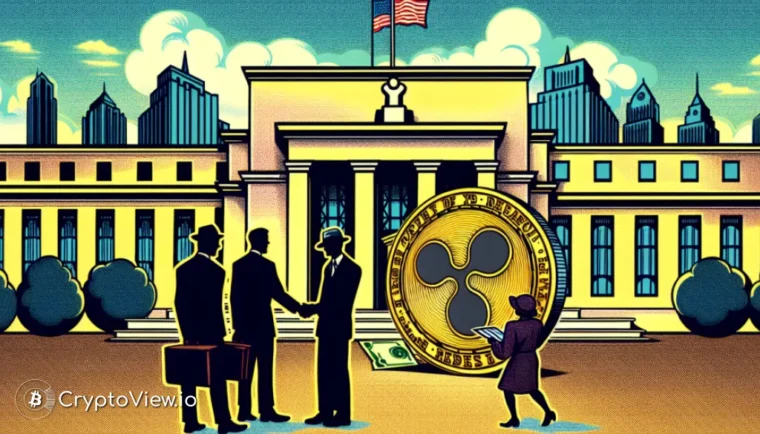
Ripple Labs Inc. recently submitted a formal comment letter to the U.S. Federal Reserve on February 6, 2026, engaging directly with monetary authorities regarding the proposed Reserve Bank Payment Account prototype (Docket No. OP-1877). This proactive stance underscores Ripple’s ambition to modernize the U.S. payment system, potentially solidifying XRP’s position as a crucial Ripple XRP bridge asset in future financial infrastructures.
Price of Ripple (XRP)
Ripple’s Strategic Outreach to the Federal Reserve
In a significant move, Ripple has formally engaged with the Federal Reserve, offering its expertise on the structure and future of direct payment accounts at the central bank level. The letter, submitted just days ago, highlights Ripple’s commitment to enhancing the safety, efficiency, and systemic resilience of payment systems. This isn’t merely a casual observation; it’s a strategic play, leveraging Ripple’s extensive experience in enterprise blockchain infrastructure, stablecoin issuance, and cross-border payment solutions.
The company views this as an opportunity to contribute to a more robust and modern financial ecosystem. By positioning itself as a key advisor in these high-level discussions, Ripple is not just reacting to regulatory proposals but actively shaping the dialogue around central bank digital currency (CBDC) and payment innovation. This engagement signals a deeper integration effort into traditional finance, a narrative that has long been central to XRP’s value proposition.
Decoding the Reserve Bank Payment Account Prototype
The Federal Reserve’s Reserve Bank Payment Account prototype is designed to explore how customized account structures can foster payment innovation while maintaining stringent risk management protocols. Ripple’s input aims to help refine this model, enabling it to function as a macroprudential tool for strengthening liquidity management and overall economic stability.
Crypto researcher BankXRP recently highlighted the transformative potential should Ripple gain access to such an account. Imagine RLUSD reserves held directly at the Federal Reserve, completely bypassing commercial bank counterparty risk. This direct settlement mechanism on Fed rails, like Fedwire, would offer unparalleled institutional-grade backing for RLUSD. Here’s why this matters:
- Direct Settlement: Payments would settle directly on Federal Reserve infrastructure, removing reliance on intermediary banks.
- Reduced Counterparty Risk: Eliminates the risk associated with commercial banks holding reserves.
- Enhanced Liquidity Management: Provides a more stable and efficient framework for managing large-scale liquidity.
- Systemic Resilience: Strengthens the overall stability of the payment system by centralizing a critical function.
This development could fundamentally redefine global liquidity, offering a glimpse into a future where digital assets are more seamlessly integrated into central banking operations.
The RLUSD & Ripple XRP Bridge Asset Synergy
The implications of this potential integration are profound for both RLUSD, Ripple’s stablecoin, and XRP. Should direct settlement on Federal Reserve rails become a reality, it would provide an unprecedented level of institutional backing for RLUSD. This, in turn, would significantly reinforce XRP’s utility in facilitating global liquidity flows and cross-border payments.
The market buzz suggests that such an alignment with central bank infrastructure could dramatically elevate XRP’s role as a primary Ripple XRP bridge asset in high-value payment corridors. Ripple’s submission also meticulously outlines its regulatory credentials, boasting over 75 global financial licenses and recent conditional approval for a national trust structure. These details are not just bureaucratic footnotes; they are strong evidence of Ripple’s readiness to operate within the most tightly regulated financial environments, showcasing its *diamond hands* in navigating complex legal landscapes.
Trend of Ripple (XRP)
Market Sentiment and the Road Ahead for XRP
This news has certainly sparked discussions across the crypto community. While some view it as a clear signal of institutional progress, emphasizing the elimination of commercial bank risk and the promise of direct settlement, others urge caution. It’s crucial to remember that this document is a comment letter submitted during a consultation process, not an approval or a confirmed grant of access. The Federal Reserve has not yet granted a Payment Account, and Docket OP-1877 remains under review.
However, Ripple’s proactive engagement confirms its strategic positioning within the ongoing discussions about the future architecture of U.S. and global payment liquidity. For investors and enthusiasts, monitoring these developments is key to understanding XRP’s long-term trajectory. Keeping an eye on on-chain metrics and market trends can provide further insights into how these foundational shifts might impact XRP’s value outlook. To stay ahead of market movements and identify potential opportunities, many find platforms like cryptoview.io invaluable for comprehensive data analysis and real-time insights. Find opportunities with CryptoView.io


