
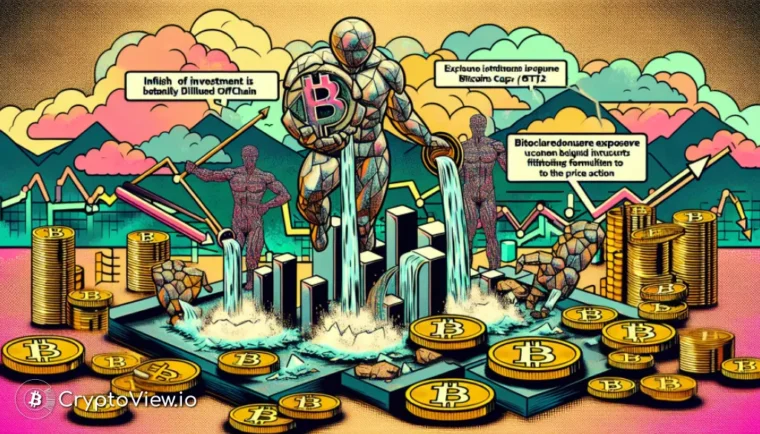
Despite over $50 billion in Bitcoin spot ETF inflows this past year, a persistent debate suggests that Bitcoin’s fundamental scarcity is being challenged off-chain. This argument, known as the paper bitcoin theory, posits that synthetic exposure instruments dilute the impact of its fixed 21 million supply, potentially decoupling price action from on-chain reality.
Price of Bitcoin (BTC)
The Rise of Synthetic Bitcoin and Its Impact
The digital asset landscape has matured significantly, introducing a plethora of financial instruments that offer exposure to Bitcoin without direct ownership of the underlying asset. Exchange-Traded Funds (ETFs), futures contracts, perpetual swaps, wrapped tokens, and various structured products all represent claims on Bitcoin. While the actual on-chain supply remains immutably capped at 21 million, critics argue that each of these off-chain products effectively creates a ‘paper claim’ on a single Bitcoin, leading to a synthetic expansion of supply.
This phenomenon, they contend, transforms Bitcoin’s price discovery mechanism. Instead of spot market demand directly influencing price, a significant portion of buying pressure is absorbed by cash-settled derivatives. This creates an environment where market participants can gain exposure, hedge, or even short Bitcoin without ever touching a satoshi, potentially dampening the impact of genuine scarcity on price appreciation. Think of it as a fractional-reserve system, but for digital assets, where a single underlying asset supports multiple layers of financial obligations.
Understanding the Paper Bitcoin Theory: A Parallel to Gold
The concept of ‘paper Bitcoin’ draws striking parallels to the ‘paper gold’ phenomenon observed in the 1980s. During that era, the gold market became heavily financialized, with derivatives like futures contracts and unallocated accounts increasingly dominating price discovery. Physical delivery became less common, and the sheer volume of paper claims on gold began to overshadow the demand for the physical metal itself.
Supporters of the paper bitcoin theory argue that we are witnessing a similar evolution with Bitcoin. Just as derivatives trading on exchanges like COMEX influenced gold prices more than physical demand, the growing derivatives market for Bitcoin could be exerting a disproportionate influence on its valuation. This allows large institutional players to manipulate short-term price movements, trigger liquidations, and cover positions at lower prices without necessarily needing to acquire actual Bitcoin, thereby distorting market signals.
The Counter-Arguments: Transparency and Market Efficiency
However, not everyone subscribes to the ‘paper Bitcoin’ narrative. Critics of the theory present several compelling counter-arguments:
- Zero-Sum Game: Derivatives markets are inherently zero-sum. For every long position, there’s a corresponding short. This means that while leverage can amplify price swings, it doesn’t create unlimited directional pressure or an infinite synthetic supply.
- Convergence to Spot: Futures and perpetual swaps are designed to converge with spot prices through funding rates, arbitrage opportunities, and expiration mechanics. Any significant divergence would quickly be exploited by arbitrageurs, bringing prices back in line.
- On-Chain Transparency: Unlike gold, Bitcoin’s on-chain supply is fully transparent and auditable. Any significant discrepancy between claims and actual reserves held by custodians would be quickly exposed, leading to a loss of trust and a flight to self-custody. You can’t audit gold with a blockchain explorer, but you can with Bitcoin.
- Market Maturity: The increasing institutional adoption of Bitcoin, while introducing new financial instruments, also brings deeper liquidity and more sophisticated hedging strategies. This could lead to smoother price movements rather than a permanent suppression of value, as markets naturally evolve and mature.
The debate highlights the tension between Bitcoin’s foundational ethos as a scarce, bearer asset and its integration into traditional finance, which often relies on layers of abstraction and leverage.
Trend of Bitcoin (BTC)
Navigating the Evolving Landscape of Bitcoin Price Discovery
The discussion surrounding the dilution of Bitcoin’s scarcity off-chain underscores a crucial point: as Bitcoin becomes more integrated into the global financial system, its price discovery mechanisms are becoming increasingly complex. While the immutable 21 million cap remains a core tenet, the influence of derivatives and synthetic exposure cannot be ignored. The question isn’t whether more Bitcoin exists on-chain, but whether the market’s perception of its value is being shaped by instruments that operate outside of its direct scarcity.
For traders and investors, understanding these dynamics is paramount. Monitoring both on-chain metrics and the health of the derivatives market provides a more holistic view of Bitcoin’s true supply and demand. Tools that aggregate and analyze these disparate data points can be invaluable. The ongoing market buzz around this topic suggests that how we define ‘ownership’ and ‘scarcity’ in the digital age is still very much an open question, one that continues to shape Bitcoin’s trajectory. If you’re looking to cut through the noise and get a clearer picture of market sentiment and on-chain activity, platforms like cryptoview.io can offer comprehensive insights. Find opportunities with CryptoView.io


