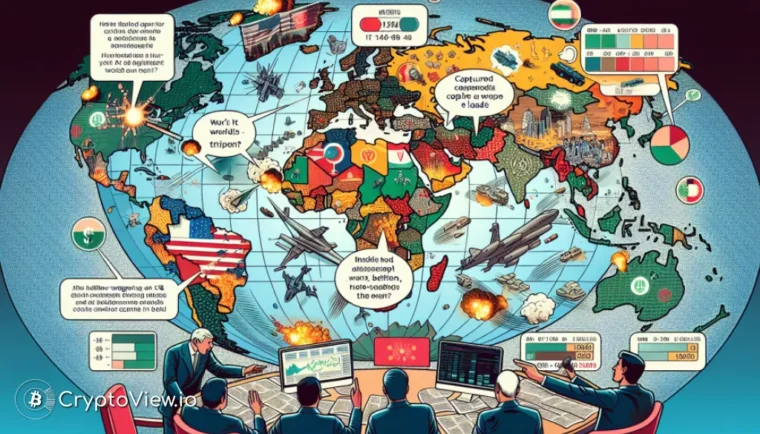
Following the dramatic capture of Venezuelan leader Nicolás Maduro, crypto prediction markets saw a significant influx of capital, with bettors actively wagering on potential US interventions globally. On-chain metrics from platforms like Polymarket revealed Iran carried the highest implied odds of a US strike at 35%, highlighting key Prediction Markets US Flashpoints for global observers.
Decoding the Prediction Markets US Flashpoints in Latin America
The aftermath of the Venezuela operation immediately shifted focus to other nations in Latin America, where geopolitical tensions simmer. Colombia, with its left-leaning President Gustavo Petro, became a prominent subject of speculation. Polymarket bettors had assigned a 16% probability that a US strike would occur by December 31, 2026. This came after former President Trump’s past criticisms of Petro, linking him to cocaine production and hinting at direct action similar to the Venezuelan intervention. Petro’s defiant response, including mobilizing troops and condemning the Maduro raid, only fueled the market’s interest.
Further retrospective analysis showed that previous forecasts indicated a 3% chance of a strike by the end of December 2025 and a 9% likelihood by March 2026. Another Polymarket wager, tracked by market observers, placed the odds of a full-scale US invasion of Colombia at 11%. Meanwhile, Mexico also entered the conversation, driven by US concerns over drug cartels, migration, and the policies of President Claudia Sheinbaum. Polymarket bettors had assigned a 13% probability that the US would strike Mexico by December 31, 2025, with a 2% chance projected by the end of that month. A separate wager gave a full-scale invasion of Mexico a 7% likelihood of materializing. Cuba, maintaining deep ties with Venezuela, also garnered attention, with Polymarket bettors placing a 19% chance on US forces striking the island by December 31, 2025. A US invasion into Cuba had a 10% chance as of early January 2026, according to Polymarket bettors, reflecting a continued, albeit lower, level of market apprehension.
Greenland’s Arctic Ambitions and Unconventional Wagers
Among the more unusual bets, Greenland surfaced as a peculiar, yet persistent, flashpoint. This interest stemmed from former President Trump’s long-standing desire to bring the Danish autonomous territory under US control, citing national security and Arctic dominance. The strategic value lies in its mineral resources, crucial for reducing reliance on China, and its geographic importance in the Arctic. Following the Maduro operation, Trump’s remarks about needing Greenland for defense explicitly linked its strategic importance to the broader context of US foreign policy.
Polymarket bettors had assigned a 13% probability that Trump would acquire Greenland before 2027. Separately, a more direct *moonshot* wager, as of January 6, 2026, put the odds of a US invasion of the region at 11%. These bets, while seemingly far-fetched, underscore how prediction markets capture even the most unconventional geopolitical scenarios, transforming political rhetoric into quantifiable probabilities that traders can engage with.
Iran: A Consistent Geopolitical Nexus
While geographically distant, Iran consistently registers as a high-stakes player in these geopolitical forecasts, largely due to its strong alliance with Venezuela. This partnership, encompassing oil deals, military cooperation, and a shared anti-US stance, including the reported presence of Hezbollah in Venezuela, places Iran firmly in the crosshairs of market speculation. Indeed, Iran carried the highest implied odds of a US strike among all nations considered, with Polymarket assigning a significant 35% probability.
Bettors had placed a 15% chance on action occurring by the end of December 2025 and a 25% likelihood by March 2026, reflecting immediate and near-term concerns. Despite the high probability of a strike, a separate Polymarket wager indicated that the odds of a full-scale US invasion of Iran by 2027 stood at a far lower 12%. This distinction between a targeted strike and a full invasion highlights the nuanced risk assessments made by participants in these markets.
Beyond the Bets: Prediction Markets as a Sentiment Barometer
Whether these market-driven probabilities ultimately align with real-world events or prove to be mere speculation, prediction markets offer a fascinating, real-time barometer of collective sentiment. They convert political rhetoric, military actions, and strategic ambitions into measurable odds, providing a unique lens through which to view geopolitical risk. The post-Venezuela period has starkly illustrated how quickly global stability can feel fragile, with decisions at the highest levels creating ripples far beyond their immediate targets. In this environment, prediction markets act as a proxy for the collective unease, capturing the *zeitgeist* of a world grappling with uncertainty. While some traders approach these markets with *diamond hands*, betting on their long-term conviction, others seek to capitalize on short-term volatility. For those looking to track these complex market dynamics and gain deeper insights into global trends, tools like cryptoview.io can offer invaluable data and analytics.
Explore cryptoview.io for market insights