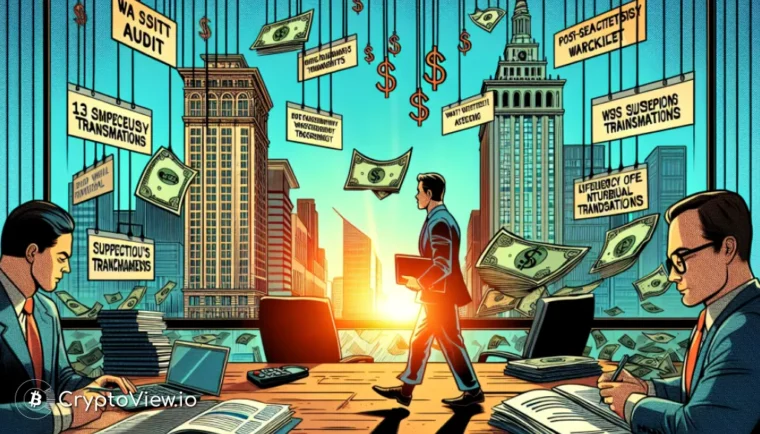
Despite a hefty $4.368 billion settlement in November 2023, Binance reportedly allowed 13 suspicious accounts to process an additional $144 million in transactions, highlighting a significant Binance compliance failure. This raises critical questions about the effectiveness of post-settlement oversight and the exchange’s internal controls, as detailed in recent reports.
Unpacking the Post-Settlement Loopholes
Leaked internal data suggests that the world’s largest cryptocurrency exchange, Binance, struggled to enforce its new, stricter Anti-Money Laundering (AML) controls even after reaching a monumental settlement with U.S. authorities in November 2023. This agreement, which included a $4.368 billion penalty and the resignation of then-CEO Changpeng Zhao, also mandated a five-year FinCEN monitorship aimed at ensuring adherence to new regulatory obligations. However, internal files seen by the Financial Times indicated that 13 specific accounts continued to operate suspiciously, moving substantial sums.
These accounts collectively transacted an estimated $1.7 billion since 2021, with a notable $144 million flowing through them *after* the November 2023 settlement. The continuation of such activity under the watchful eye of regulators points to persistent challenges in fully implementing and enforcing compliance protocols. The very premise of the monitorship was to prevent such occurrences, making these revelations particularly concerning for the exchange’s future regulatory standing.
Red Flags and Rogue Transactions: A Deeper Dive
The details surrounding these 13 accounts paint a vivid picture of potential illicit activities that slipped through Binance’s revamped compliance net. One account, for instance, was registered to a 25-year-old Venezuelan woman who received over $177 million in crypto between April 2022 and April 2024. Alarmingly, this account altered its payment details 647 times between January 2023 and March 2024, utilizing 496 different bank accounts across the Americas. Such rapid and extensive changes are typically considered significant red flags in financial compliance.
Another suspicious account belonged to a 30-year-old junior bank employee in Caracas, which saw $93 million in crypto inflows and comparable outflows between 2022 and May 2025. A particularly glaring indicator of potential wrongdoing was an IP log showing access from Caracas at 3:56 PM on February 24, 2025, followed by access from Japan at 1:30 AM the very next day. This geographical impossibility within such a short timeframe strongly suggests the use of VPNs or other obfuscation techniques. Furthermore, between February 2022 and March 2023, all 13 accounts collectively received $29 million in USDT from wallets later frozen by Israel due to alleged links to terrorism financing, with most funds originating from accounts associated with Syrian Tawfiq Al-Law, who has been sanctioned for facilitating illicit transfers for groups like Hizbollah and the Houthis.
The Broader Implications of Binance Compliance Failure
This ongoing struggle with illicit transactions could have severe repercussions for Binance. The exchange and its co-founder, Changpeng Zhao, are already facing a new lawsuit filed earlier in December 2025, alleging the creation of a system that enabled crypto transactions linked to Hamas over a six-year period. This civil action adds to a growing list of legal challenges accusing the company of facilitating transactions for U.S.-designated terrorist organizations.
The potential for further financial penalties is a tangible threat. The 2023 settlement included a suspended penalty of $150 million, which could be activated if Binance fails to satisfy its ongoing obligations. The FinCEN monitorship was established precisely to oversee remedial undertakings, conduct periodic reviews, and report findings to FinCEN, OFAC, and the CFTC. Any indication that Binance is not fully cooperating or effectively implementing the agreed-upon measures could lead to escalated regulatory action and significant damage to its reputation, eroding market confidence.
Navigating the Regulatory Maze: What’s Next for Binance?
The road ahead for Binance appears to be a complex regulatory maze. While the exchange has publicly stated it possesses “robust systems in place to flag and investigate suspicious transactions and take action where appropriate,” the leaked data suggests that these systems may not be as impenetrable as claimed. The ongoing FinCEN monitorship is crucial; its findings will largely dictate the exchange’s trajectory over the next few years. The crypto market buzz indicates that institutional investors and retail traders alike are closely watching how Binance addresses these persistent compliance issues, as regulatory certainty is key to broader adoption.
For those tracking the ever-evolving landscape of crypto regulations and exchange compliance, tools that offer deep insights into market movements and on-chain metrics are invaluable. Staying informed about such developments can help investors and traders make better decisions in a volatile market. For detailed analytics and real-time data, platforms like cryptoview.io can offer a significant edge. Find opportunities with CryptoView.io