
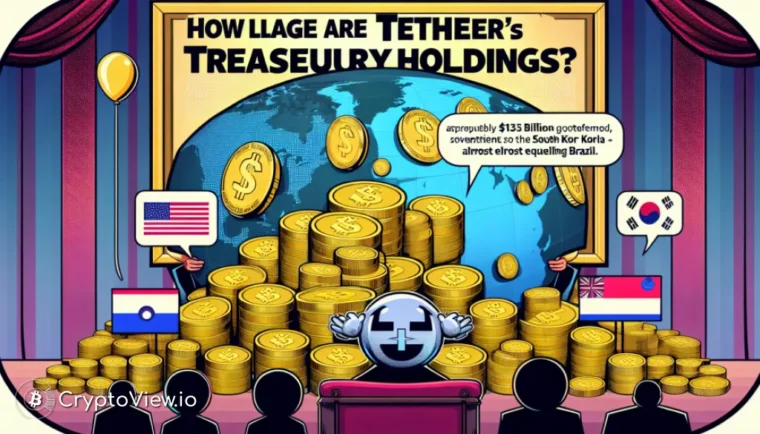
Tether, the issuer of the world’s largest stablecoin USDT, has significantly expanded its portfolio of U.S. Treasury bills, now holding approximately $135 billion. This substantial investment positions Tether US Treasury holdings as the 17th largest globally, remarkably surpassing sovereign nations like South Korea and nearing Brazil, underscoring its growing influence in global financial markets.
Tether’s Expanding Footprint in US Treasury Holdings
The stablecoin behemoth, Tether, has cemented its status as a major player in traditional finance by amassing an impressive $135 billion in U.S. Treasury bills. This figure, as disclosed recently by the company, places Tether in an elite league, surpassing the national debt holdings of countries like South Korea and inching closer to Brazil. This development is not just a testament to Tether’s financial strength but also highlights the profound integration of dollar-pegged crypto assets into global liquidity flows, particularly within the short-term bond market.
This strategic accumulation of U.S. debt signals a maturing stablecoin ecosystem that is increasingly interacting with conventional financial instruments. It reflects a broader trend where digital assets are no longer confined to niche crypto circles but are becoming meaningful participants in the broader economic landscape, influencing sovereign debt markets and capital allocation on a global scale. This significant position underscores the critical role stablecoins now play in bridging the gap between decentralized finance and traditional banking.
Regulatory Shifts and Stablecoin Innovation
The stablecoin market is currently navigating a complex phase marked by evolving regulations and intensifying competition. A pivotal moment arrived with U.S. President Donald Trump’s signing of the GENIUS Act, which aimed to establish a clearer regulatory framework for compliant stablecoins operating within the U.S. market. In direct response to this legislative shift, Tether introduced USA₮, a new dollar-backed token meticulously designed to align with these stringent U.S. regulatory requirements, showcasing the industry’s commitment to compliance and adaptation.
This regulatory push has spurred innovation and expansion across the stablecoin landscape. Rival issuer Circle, for instance, has been actively forging new partnerships and enhancing its infrastructure to broaden its reach. Similarly, international players, such as Japan’s JPYC, are scaling their operations to tap into the burgeoning global demand for stablecoins. These strategic moves by various stablecoin issuers underscore a dynamic environment where regulatory adherence and market expansion are key drivers of growth and competition.
The Stablecoin Arena: USDT, USDC, and Market Dynamics
Stablecoins continue to facilitate colossal transaction volumes, demonstrating their utility and widespread adoption. Recent on-chain analytics from Visa reveal that stablecoins processed an astonishing $6.4 trillion in total transfers over the past 30 days. While USDT traditionally leads market activity, recent October 2025 data points to a notable shift in competitive dynamics. During this period, USDC recorded approximately $669.15 billion in monthly transaction volume, slightly outpacing USDT’s $607.98 billion. This indicates that while USDT retains its overall market share and circulation dominance, USDC is making significant inroads in payments and institutional pipelines.
Despite USDC’s gains in transaction volume, an analysis from August 2025 indicated that USDT still commanded a formidable 79% market share. However, this dominance appears to be gradually eroding as USDC’s transparent operations and fully liquid reserves, overseen by BlackRock, appeal to a growing segment of institutional investors. In contrast, USDT’s reserve composition, which includes a mix of assets ranging from U.S. Treasuries to Bitcoin and commodities, has often been a subject of debate. Nevertheless, the market witnessed a fascinating event on October 10th, when a flash de-peg saw USDT briefly trade above $1 while USDC experienced a dip. This incident powerfully illustrated that stability in stablecoins isn’t solely about reserve composition; it’s also about real-world performance and market trust, reminding us that sometimes, even in the crypto world, *diamond hands* are for those holding the most reliable assets.
The ongoing competition between these two stablecoin giants reflects a maturing market where users prioritize different aspects, from regulatory compliance and transparency to liquidity and real-time performance. The sheer scale of Tether US Treasury holdings, alongside its diversified reserve strategy, continues to be a cornerstone of its market position, even as rivals like USDC carve out their own niches.
Beyond Digital Dollars: Tether’s Foray into AI
Tether is not content to simply dominate the stablecoin market; the company is actively diversifying its portfolio into cutting-edge technological sectors. Tether Data, the firm’s dedicated technology unit, recently unveiled QVAC Genesis I, a massive 41-billion-token synthetic dataset. This groundbreaking dataset is specifically designed to train advanced AI models focused on science and engineering applications, showcasing Tether’s ambition to contribute to the broader tech ecosystem.
Alongside QVAC Genesis I, Tether Data also introduced QVAC Workbench, an innovative application that empowers users to run these sophisticated AI models directly on their local devices. This move into artificial intelligence represents a significant strategic expansion for Tether, positioning the company at the forefront of emerging technologies. It signals a vision that extends far beyond stablecoins, aiming to leverage its technological capabilities to drive innovation in fields like AI and data science. For those looking to keep a finger on the pulse of these dynamic market shifts and explore new opportunities, platforms like cryptoview.io offer invaluable tools for market analysis and portfolio management. Find opportunities with CryptoView.io


