
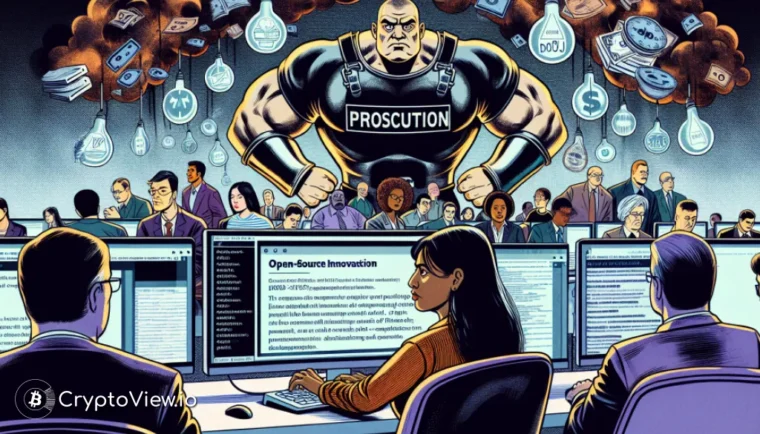
Following Roman Storm’s August 2025 conviction for operating an unlicensed money transmission business, a stark question hangs over the decentralized finance (DeFi) sector: Are developers truly safe from legal repercussions? This landmark case, involving the Tornado Cash protocol, has intensified concerns about the potential for DOJ prosecution DeFi developers, pushing the community to re-evaluate regulatory boundaries and the future of open-source innovation.
The Storm Verdict: A Precedent for Open Source?
Roman Storm, a key developer behind the privacy-focused Tornado Cash protocol, found himself at the center of a legal storm, culminating in an August 2025 conviction. The jury found him guilty of conspiracy to operate an unlicensed money transmission business, a verdict that immediately sent ripples through the crypto community. This outcome wasn’t a clean sweep for the prosecution; the jury remained gridlocked on more severe charges of money laundering and sanctions violations, failing to reach a unanimous consensus. Nevertheless, the conviction on the unlicensed money transmission count has ignited a fierce debate: Does this set a dangerous legal precedent for open-source software developers globally? The fear is palpable, as developers ponder whether their contributions to decentralized, non-custodial protocols could retroactively be deemed illegal, especially concerning the potential for DOJ prosecution DeFi developers.
The Core Debate: Code vs. Intent
At the heart of Storm’s defense, and indeed the broader discussion, was the argument that Tornado Cash operates as a truly decentralized software protocol, beyond the control of any single entity or individual. Storm’s legal team, citing his September 30 motion for acquittal, highlighted that “Our company does not have any ability to affect any change, or take any action, with respect to the Tornado Cash protocol — it is a decentralized software protocol that no one entity or actor can control.” This distinction between merely writing code and actively participating in an illegal enterprise is crucial. The prosecution, however, seemed to argue that even non-custodial services should have been developed as custodial ones, implying a responsibility on developers to foresee and prevent illicit use.
This legal tightrope walk has left many developers questioning their liability. If building a non-custodial protocol can be interpreted as operating a money service business, then the very foundation of open-source DeFi, which thrives on permissionless innovation, could be undermined. The community is watching closely, seeking clarity on where the line is drawn between creating neutral tools and being held accountable for their misuse by bad actors.
Shifting Sands: DOJ’s Evolving Stance
Amidst the uncertainty following Storm’s conviction, a glimmer of reassurance emerged from the Department of Justice itself. In August 2025, Matthew Galeotti, the acting assistant attorney general for the DOJ’s criminal division, publicly signaled that the department would not pursue a retrial against Storm on the deadlocked charges. More significantly, Galeotti stated that the DOJ had no intention of prosecuting similar cases, offering a nuanced perspective. He explicitly articulated, “Our view is that merely writing code, without ill intent, is not a crime.” This statement, delivered at the American Innovation Project Summit, aimed to assuage fears that the DOJ might use indictments as a “law-making tool” or leave innovators “guessing as to what could lead to criminal prosecution.” This stance, if consistently upheld, could be a significant relief for developers who HODL onto the vision of a truly decentralized future.
The Path Forward for DeFi Innovation
The Roman Storm case serves as a stark reminder of the regulatory challenges inherent in the rapidly evolving DeFi landscape. While the DOJ’s recent assurances offer some comfort, the legal battle underscores the critical need for clearer guidelines and robust advocacy for pro-crypto legislation in the US. Developers, now more than ever, are encouraged to engage with legal counsel and stay informed about the shifting regulatory environment. The crypto market buzz suggests that while innovation won’t halt, it will likely proceed with a heightened sense of caution, emphasizing compliance by design. For those tracking these complex developments and seeking to understand market sentiment, platforms like cryptoview.io offer valuable insights into the digital asset space, helping users navigate the currents of regulatory news and market trends. The future of decentralized finance hinges on a delicate balance between fostering innovation and ensuring legal clarity, preventing further instances of DOJ prosecution DeFi developers for their contributions to open-source code.


