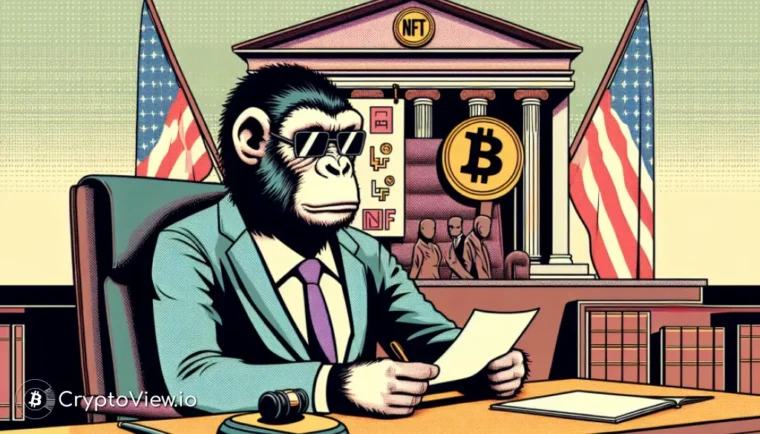
A recent federal court decision in California has definitively declared that Bored Ape NFTs not securities, marking a significant legal victory for Yuga Labs. This ruling, dismissing a class-action lawsuit, hinged on key distinctions regarding their marketplace sales and creator royalty structures, offering crucial clarity for the broader digital asset market.
The Landmark Ruling: Deconstructing the Decision
In a pivotal decision, U.S. District Judge Fernando M. Olguin, appointed in 2013, dismissed a class-action lawsuit against Yuga Labs, the creators behind the iconic Bored Ape Yacht Club (BAYC) NFT collection. The core of the ruling, issued earlier this year, centered on whether BAYC NFTs met the criteria to be classified as securities under federal law. Judge Olguin’s analysis highlighted fundamental differences between Bored Apes and other digital collectibles that had previously been considered plausible securities, such as Dapper Labs’ NBA Top Shot NFTs or DraftKings’ offerings.
A crucial factor in the court’s reasoning was the method of acquisition. Unlike some other NFT projects where sales occurred on issuer-controlled platforms, plaintiffs in the Yuga Labs case acquired their Bored Ape NFTs on independent, third-party marketplaces like OpenSea and Coinbase. This distinction proved vital, as it diluted the direct ‘interplay’ between the issuer’s ecosystem and the buyers’ investments, a key element often scrutinized in securities assessments.
Understanding the Howey Test and “Common Enterprise”
At the heart of classifying an asset as a security lies the venerable Howey Test, a framework established by the U.S. Supreme Court. One of its critical prongs requires the presence of a “common enterprise”—meaning investors’ fortunes are inextricably linked to the efforts of the promoter or a third party. Judge Olguin determined that Bored Ape NFTs not securities because they failed to trigger this essential component.
The court found insufficient evidence of the type of “horizontal commonality” that would tie the fate of individual Bored Ape holders directly to Yuga Labs’ ongoing efforts in a manner consistent with a security. The decentralized nature of secondary market sales, combined with other factors, suggested a detachment from the direct, continuous promotional efforts typically associated with a common enterprise in a securities context. This legal interpretation provides a significant precedent for how future NFT projects might be viewed under securities law.
Creator Royalties: A Decoupling of Fortunes
Another compelling argument that swayed the court involved creator royalties. Yuga Labs, like many NFT issuers, collected a royalty fee on every secondary sale of a Bored Ape NFT. While the SEC has historically argued that such royalties could indicate a security, suggesting creators encourage resale for financial gain, Judge Olguin presented a contrasting view.
The judge concluded that these creator royalties actually implied a *de-coupling* of the plaintiffs’ financial fortunes from those of Yuga Labs. Even if a holder sold their NFT at a loss, Yuga Labs would still receive its royalty fee. This mechanism, in the court’s eyes, suggested that the economic interests of the NFT holders and the issuer were not perfectly aligned in a way that would classify the asset as a security. This perspective offers a nuanced take on a contentious aspect of NFT economics that has been a focal point for regulators.
Market Impact and Future Outlook for Digital Assets
Despite the profound legal significance of this ruling, the immediate market reaction to the news for Bored Ape NFTs was somewhat muted. While the decision provides much-needed legal clarity for Yuga Labs and the broader NFT sector, the collection’s floor price has remained considerably below its all-time highs. For instance, the floor price for BAYC NFTs, which peaked at approximately $369,900 in April 2022, was trading significantly lower, reflecting a broader market correction for many digital collectibles. Even with this legal win, the journey back to previous valuation peaks for these once red-hot status symbols remains an uphill battle, requiring more than just legal validation; it needs sustained market demand and utility.
This landmark ruling, coupled with the U.S. Securities and Exchange Commission’s earlier decision in March 2025 to close its investigation into Yuga Labs without enforcement action, provides a significant boost of confidence for the NFT industry. It suggests a growing legal and regulatory framework that differentiates NFTs from traditional securities, potentially paving the way for further innovation and mainstream adoption. For those looking to navigate these complex digital asset markets and track the performance of various collections, tools like cryptoview.io can offer invaluable insights into market trends and project fundamentals. This clear stance on Bored Ape NFTs not securities could embolden creators and investors alike, fostering a more robust and predictable environment for the next wave of digital assets. Unlock market insights with CryptoView.io