
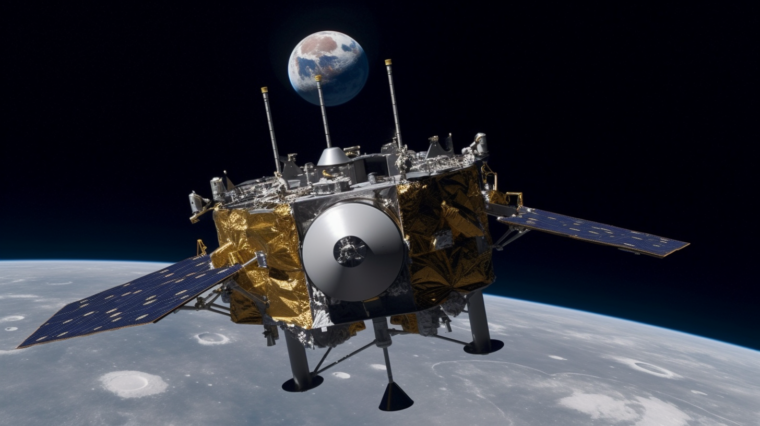
Following a hiatus that lasted decades, Russia is once again venturing into lunar exploration with the Luna 25 mission. This mission is Russia’s first since the Luna 24 sample return mission in 1976. As global space ambitions heat up, Russia is staking its claim alongside the United States and China. The Luna 25’s successful launch not only highlights Russia’s determination but also the challenges it faces in interplanetary exploration.
The Long Pause in Russia’s Lunar Exploration
Russia’s Luna 25 mission represents a rekindling of its historic space exploration achievements, particularly its pioneering role in interplanetary missions. The last lunar probe launched by Russia was almost half a century ago, and its success in reaching any other planetary body goes back to 1988. The Luna 25’s journey to the moon is just the beginning of this ambitious mission, with the spacecraft’s powered descent to the lunar surface posing the biggest challenge.
Reviving Lunar Exploration
The Luna 25 mission is about more than nostalgia for Russia. It’s about reclaiming its prominence in interplanetary exploration. The Luna 24 mission marked Russia’s last lunar venture in 1976, while China’s Chang’e 5 accomplished a sample return mission in 2020. Despite the challenges, Russian probes have previously landed on the Moon and other planetary surfaces, contributing to the field of space exploration.
Collaboration and Competition in Space
While Russia and China’s collaboration in lunar exploration seemed promising, the dynamics have changed. Russia’s space budget constraints and ongoing geopolitical complexities have influenced the trajectory of its space program. Consequently, the partnership’s scope was scaled back, and China independently pursued its lunar ambitions, inviting other nations to join its lunar program.
The Luna 25 mission has been fraught with setbacks and revisions. Initial concepts for the mission surfaced in the 1990s, but funding challenges delayed substantive progress. Russia explored partnerships with Japan and India, but these collaborations did not materialize. Luna 25’s status as a solely Russian endeavor raises questions about the mission’s feasibility and success.
As Luna 25 embarks on its journey, it carries with it significant scientific objectives. The spacecraft is equipped with eight scientific instruments, including cameras, spectrometers, and monitors for radiation and dust. A robotic arm will collect soil samples for chemical analysis, offering insights into the Moon’s composition.
The future of lunar exploration is crowded, with China and the United States maintaining active lunar missions. Japan’s SLIM mission is scheduled for August 25, while India’s Chandrayaan 3 aims to land two days after Luna 25’s targeted touchdown. Russia’s commitment to lunar exploration is exemplified by its determination to reignite its lunar program. Despite the challenges, Luna 25 underscores the enduring allure and scientific potential of lunar exploration.
For those interested in keeping up-to-date with the progress of the Luna 25 mission and other space-related news, the cryptoview.io application offers real-time updates and in-depth analysis.
Stay informed with cryptoview.io
The Luna 25 mission marks a pivotal moment in Russia’s space ambitions, reigniting its legacy of lunar exploration. As the spacecraft begins its mission to land on the Moon, Russia seeks to carve a unique path in a landscape increasingly shared by international players. While challenges persist, Luna 25 highlights the enduring allure and scientific potential of lunar exploration on the global stage.


