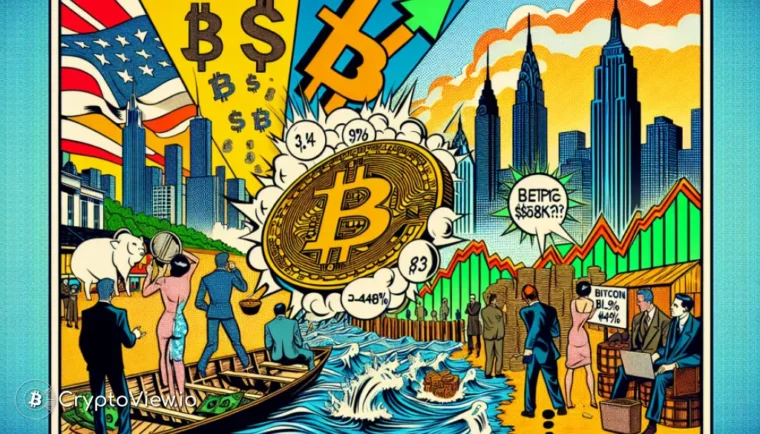
The recent surge in the US Consumer Price Index (CPI) has surpassed predictions, recording a rise of 3.4%. This unexpected increase, which has outpaced the forecasts of numerous economists, indicates an ongoing inflationary trend in the US economy. Concurrently, the price of Bitcoin is breaking out of its $46K consolidation zone and is on track to reach the $48K level.
US Inflation Rate Soars to 3.4%
The US Bureau of Labor Statistics (BLS) declared last Thursday that the US inflation rate, as measured by the CPI, climbed to an annual rate of 3.4% in December. This rise, which followed a 3.1% increase in November, surpassed the anticipated market projection of 3.2%. Furthermore, the CPI saw a 0.3% monthly increase, outstripping the predicted rise of 0.2%.
The Core CPI, which excludes the fluctuating food and energy prices, aligned with expectations, showing a monthly increase of 0.3%. Over the year, the Core CPI registered a 3.9% increase, a slight drop from November’s 4%.
Key Factors Driving Inflation
In its press release, the BLS emphasized that the shelter index continued its upward trend in December, contributing to over half of the total monthly increase in all items. Energy prices rose by 0.4% during the month, fueled by increases in both electricity and gasoline indexes, which more than offset the decrease in the natural gas index.
The food index noted a 0.2% rise in December, mirroring the increase from the previous month. Within this category, the index for food at home nudged up by 0.1%, while the index for food away from home saw a marginally higher increase of 0.3%.
Bitcoin Prices Respond to Inflation Data
Despite the SEC’s approval of a spot ETF failing to spur Bitcoin’s price to reach $48,000, the escalating inflation rate is now fueling demand for Bitcoin. This comes as various ETFs continue to be traded on exchanges. Bitcoin’s price experienced a substantial increase, rising from a low of $46,800 to a high near $48,000. Investors frequently resort to cryptocurrencies as a safeguard against rising inflation.
Traditional assets tend to depreciate in value during periods of high inflation, while assets like Bitcoin, due to their deflationary nature and capped supply, often witness a surge in buying demand. Inflation, which had seen a decrease in the fall, experienced a slight increase in December. This rise underscores that it may be too soon to dismiss concerns following the most significant surge in consumer prices in four decades.
As we witness these market dynamics, platforms like cryptoview.io can provide valuable insights into the interplay between economic indicators and cryptocurrency prices. This can be especially useful for investors looking to hedge against inflation with digital assets.